Water Element: Flow, Winter, and the Kidneys' Deep Reserve
Why the Water element rules winter, the kidneys, and the deep reserves. How to spot a Water person, what imbalance looks like, and how to restore flow.
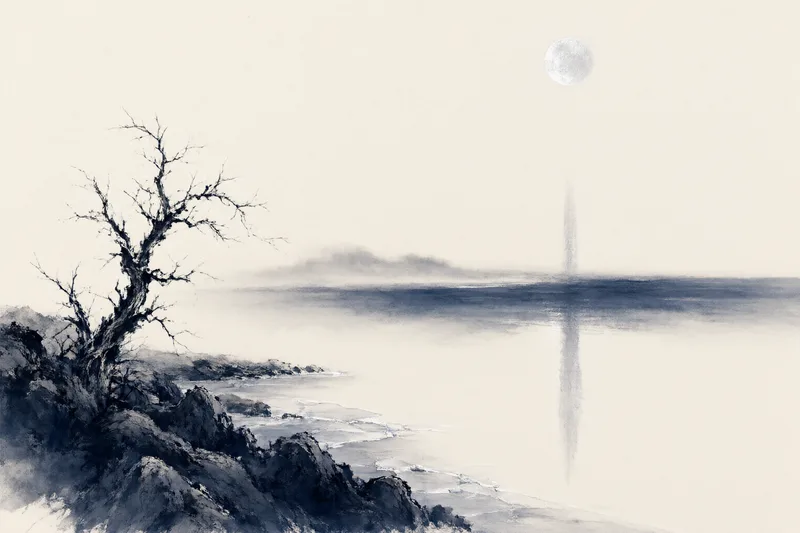
A lake near the town where I grew up froze solid every January. People skated across it, and by March the ice was thick enough for trucks. What almost nobody thought about was the water underneath. Freshwater is densest at four degrees Celsius, so the bottom of that lake stayed liquid all winter and every fish in it survived under a lid of ice. The surface made all the noise. The depth kept everyone alive.
Water is the element of that kind of depth. In the five-element system it rules winter, the north, the kidneys, and the long quiet reserves a person draws on when everything else has run out. It is the phase of stillness, fear, and a particular kind of intelligence that only shows up once the noise stops.
This is what the Water element actually governs, from season to body to temperament, and what it looks like when yours runs deep, runs dry, or freezes over.
The element of depth
Every element arrives with a full set of correspondences, and Water’s cluster is the coldest and the quietest.
Winter is its season, the months when a tree has no leaves to show and everything that matters has moved underground. Its direction is the north, the direction cold comes from. Black and deep blue are its colors, the shades of night, deep water, and the sky before snow. Its shape is wavy and irregular, the outline of a river rather than a wall. Its climate is cold, its taste is salty, and its movement is downward. The character for Water, 水, is a pictograph of a river running between its two banks.
The two Heavenly Stems that carry the phase split it the same way Earth splits into mountain and field. 壬 (rén) is Yang Water: the ocean, the flood, the river that will not be argued with. 癸 (guǐ) is Yin Water: rain, mist, dew, the small persistent drip. Most people carry both. You can be an ocean in public and a leak in private, or the other way around.
Water’s virtue is 智 (zhì), wisdom. Not the wisdom of facts, which belongs closer to Metal, but the wisdom of timing: knowing when to wait, when to move, and how much of a thing is enough. The Inner Canon also attaches 志 (zhì), the will, to Water, and stores it in the kidney (肾藏志). Same sound, different character from 智. Deep reserves are what make insight and persistence possible in the first place.
In the older cosmological schemes Water is the most Yin of the five phases. It is number one and number six in the He Tu diagram (天一生水, 地六成之), and its trigram is Kan ☵, one unbroken line between two broken ones. Yang held inside Yin. The spark of heat at the bottom of the well.
What a Water person looks like
Physically, the old texts describe the Water type as slim or softly rounded, with a certain stillness in how they stand, dark or deep-set eyes, and a way of listening that makes you finish your sentence differently than you planned. Hair and skin quality matter here, because in Chinese medicine they reflect the kidney’s store of essence. The type is a lean, not a rule.
Temperament is where Water becomes unmistakable. A Water person:
- talks less than the room and notices more
- asks the question nobody else asked, then waits for the real answer
- is comfortable alone in a way that unsettles people who are not
- keeps a long memory and a longer patience
- withdraws instead of arguing, and the withdrawal is a statement
- can endure hard conditions quietly for years
- trusts instinct over proof, and is usually right about people
The virtue is real. Water people are the ones still standing after the enthusiasm has burned off. They take the night shift, the long project, the relative nobody visits. Their strength is not speed. It is staying power.
The shadow is just as consistent. Water can go cold, distant, and suspicious. It reads as detached when it is actually afraid. It hoards energy, avoids being seen, and calls its withdrawal a boundary when it is really a hiding place. At its worst it turns cynical, the person who has seen the trick behind every curtain and no longer expects anything good.
Water in the body: the kidneys and the bladder
In Chinese medicine, Water anchors to the kidney (肾 shèn) and the bladder (膀胱 pángguāng).
A note before anything else, the same one that matters for every element: the Chinese kidney is not the Western kidney. It is closer to the whole system of reserves, the deep account a body draws on for growth, reproduction, repair, and endurance. The classical texts call it the root of the congenital constitution (先天之本), the part of you that came in the door with you. It stores jing (精), usually translated as essence, the substance behind bone, marrow, teeth, hair, and the ability to recover.
The kidney opens into the ears, governs the bones, and shows its health in the hair and the lower back. When it is strong, the bones are dense, the teeth hold, the hair has body, hearing is sharp, and you wake up with something in the tank. When it is depleted, the signs are specific: a dull ache in the lower back, cold knees and feet, tinnitus, loose teeth, brittle hair and nails, frequent urination at night, night sweats, and a tiredness that sleep does not fix.
The emotion of Water is fear, 恐 (kǒng). The classic line is 恐伤肾, fear injures the kidney, and its companion line explains the mechanism: 恐则气下, fear makes the qi descend. This is one ancient formula you can watch happen in real time. Extreme fright makes people urinate, go weak in the knees, or freeze. The body drops its energy to the floor. The healthy version of the same energy is caution, the kind that reads a situation before entering it. The unhealthy version is dread that keeps circling with no threat in sight.
In the organ clock, the bladder peaks between 3 and 5pm and the kidney between 5 and 7pm. It is the stretch when the day should be winding down rather than ramping up, which is why a second coffee at six lands so badly. If you want to see how your own clock runs, our Chinese Body Clock tool maps the full 24 hours.
Where Water sits in the cycle
Water’s position explains its personality better than any list of traits.
In the generating cycle, Metal feeds Water. Condensation forms on cold metal, and a vessel holds water and gives it shape. This is why a Water person needs structure. It keeps them from spreading. Metal is precision, routine, clean edges. Water without Metal spreads into a puddle, and the person drifts without ever deciding.
Water, in turn, feeds Wood. Nothing grows without it. This is the transition from winter to spring, from stillness to plan, and it is the most natural springboard in the system: reserves become growth. A person who has rested deeply starts the year with something to spend. A person who has not starts it borrowing.
In the controlling cycle, Earth restrains Water. It is the bank and the dam. This is the useful friction between the steady one and the deep one. Earth gives Water an edge to push against, and without it Water floods. Too much Earth and the Water person feels buried, contained until they go stagnant. Too little and they drift, capable of anything and committed to nothing.
Water controls Fire. It is the relationship between depth and display, the quiet one and the bright one. Water cools the fire that would burn itself out. Fire gives Water a reason to come to the surface. Too much Water and the Fire person loses their spark. Too little and Water has nothing warm to reach for.
When Water runs too strong
Excess Water is cold and heavy, and it is hard to see from outside because it looks like calm.
The signs: a sense of dread with no object, suspicion of people who have done nothing wrong, cold limbs, a puffy face in the morning, water retention, low energy that gets worse in winter, nightmares, a preference for staying in, and a mind that rehearses disasters it has no intention of preventing. The body can feel damp and heavy, the way a basement feels after a week of rain.
The emotional signature is isolation dressed as self-sufficiency. Water in excess pulls inward until there is no one left in the room. It hoards energy and attention, and it treats every invitation as a risk. The person may genuinely love solitude. They have also stopped being able to tell the difference between solitude and hiding.
The traditional correction is Earth and Wood. Earth gives the water a bank: routine, structure, a fixed schedule, a commitment with a time on it. Wood gives it somewhere to go: a project, a plan, a reason to move. Physically the advice is to warm up, dry out, and move. Sunlight, hot food, exercise, and contact with people who expect you to show up will do more than another night alone with your thoughts.
When Water runs too low
Depleted Water is the modern condition, and it is easy to mistake for ordinary ambition.
The signs: a lower back that aches by afternoon, knees that feel older than they are, dry skin and thinning hair, tinnitus, night sweats, hot flashes, insomnia that wakes you in the small hours, frequent urination, and a tiredness that a full night does not touch. The body has spent its reserves and is now borrowing from the structure itself.
The emotional picture is brittle courage and free-floating fear. The person keeps pushing because stopping would reveal how empty the tank is. They are irritable in a thin, high-strung way, moved by small things, and privately certain that rest is a luxury they cannot afford. There is often a long stretch of overwork, grief, illness, or chronic stress behind it, and the crash arrives later than anyone expects.
You cannot fix low Water with more willpower. Willpower is what spent it. The response is to rebuild the reserve in the slowest, least impressive way: sleep before eleven, eat warm food at regular times, cut the stimulants, and stop treating every hour as production. If you have a full birth chart, the Bazi calculator shows whether Water is present, missing, or present but unsupported, which changes the strategy.
Bringing Water back to balance
Balance for Water is depth, not motion. The goal is a full tank, not a fast current.
Sleep is the first medicine. Winter is the season of going to bed early, and the kidney does most of its repair at night. The old advice is to be asleep before 11pm, because the body’s deepest repair begins before midnight and cannot be fully recovered later. If you change only one thing, change this one.
Drink warm, and drink enough. Water balances Water, but not the way people assume. Iced drinks and constant cold water ask the kidney to warm what you swallowed before it can use it. Warm or room-temperature water, sipped through the day, is the traditional approach. Enough means pale yellow urine, not colorless.
Keep the lower back and feet warm. The kidney governs the lower back and the bones, and cold enters there first. A warm layer at the waist, warm socks, and a hot bath in winter are not fussiness. They are direct maintenance.
Eat the black foods. In Chinese dietary therapy the kidney is fed by dark foods: black beans, black sesame, walnuts, seaweed, black rice, bone broth, and small amounts of good salt. The salt connection is real and easy to overdo. The kidney needs some salt and suffers from too much, the same way it needs some fear and suffers from too much of that.
Move, but do not exhaust. Water people often mistake depletion for depth. The right movement is steady and restorative: walking, swimming, slow qigong, standing meditation (站桩 zhàn zhuāng). The wrong movement is the one that leaves you more spent than you started.
Practice stillness on purpose. Water’s gift is the ability to be quiet without being empty. Ten minutes of sitting before the phone is enough to notice the difference between calm and numbness. The first feels full. The second feels like a room with the furniture removed.
Give fear a container. Since 恐伤肾, chronic fear is not just unpleasant, it is expensive. Name the fear on paper, put a boundary around it, and decide what you will do. Most dread shrinks when it is written down, because writing turns it from a weather system into a problem with an address.
Say no to one obligation. The kidney is the organ of reserves, and overcommitment is a slow leak. One honest no per week is a form of rest that costs nothing and returns more than an extra hour of sleep.
Seasonally, winter is the Water renewal window. It is the one time of year when the correct advice is to do less, go to bed earlier, eat warmer, and let the surface stay quiet. The culture will tell you this is laziness. The system will tell you it is how the next year gets funded.
The Water element is not a personality label. It describes where your reserves come from and how you spend them. Learn to read it and you stop confusing exhaustion with depth, and you stop treating a full tank as a luxury. You sleep before the debt is called in. You keep the lower back warm. You let the lake freeze on top and stay liquid underneath.
If you want to know where your own five elements sit, our Five Elements Quiz takes about two minutes and returns your dominant and secondary elements. For the deeper layer, the Five Elements Personality Report maps your chart against each element’s strengths and shadow sides, with a section on what depletes Water fastest and how to rebuild it.
New to the five elements? The Complete Guide to the Five Elements explains the generating and controlling cycles in full. The series continues with the Wood element, the Fire element, and the Earth element.
Frequently Asked Questions
How do I know if my dominant element is Water?
The fastest way is a short personality quiz. In five-element terms, Water people talk less than the room and notice more, keep a long memory, endure hard conditions quietly, and trust instinct over proof. They need solitude to recharge and they withdraw instead of arguing. A full chart reading confirms it from your birth date and time.
What body parts does the Water element govern?
The kidneys and the bladder, with the bones, marrow, teeth, ears, and hair closely tied in. In Chinese medicine the kidney is the organ of deep reserves and stores jing, the essence behind growth and repair. Water imbalance often shows up as lower back ache, cold knees and feet, tinnitus, night sweats, or a tiredness that sleep does not fix.
What happens when Water is out of balance?
Too much Water shows as dread with no clear object, suspicion, cold limbs, water retention, and a pull toward isolation. Too little shows as depleted reserves: a sore lower back, dry skin and thinning hair, night sweats, insomnia, and a brittle, driven kind of fatigue. Both read as a lake that is either flooding its banks or running too low to hold fish.
What is the best way to balance Water in daily life?
Sleep before eleven, which is the single highest-return change. Drink warm water through the day instead of iced drinks, keep the lower back and feet warm, eat dark foods like black beans and black sesame, and move in a way that restores rather than exhausts. Give chronic fear a container by naming it and deciding what you will do.