Earth Element: Stability, Late Summer, and the Spleen
Why the Earth element rules late summer, the spleen, and the center. How to spot an Earth person, what imbalance looks like, and how to find your ground.
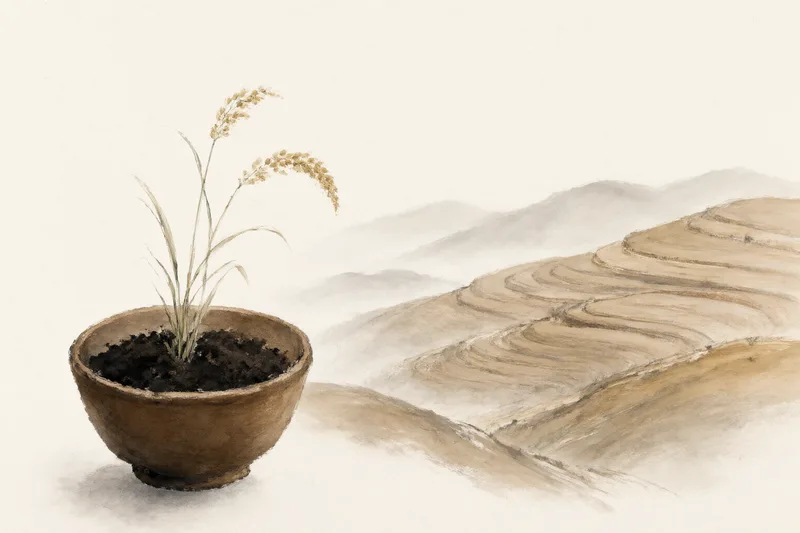
A friend who throws pots once told me that clay remembers. Dry a bowl too fast and it cracks along a seam you forgot to score, and ten rushed minutes undo a week of work. Everything holds only if the base holds.
Earth is the element of that base. It is late summer, the short pause between the peak of heat and the harvest, and it sits at the center of the wheel rather than on any edge of it. In the five-element system it is the phase everything else rests on, which is exactly why it is so easy to overlook. Nobody thanks the floor.
This is what the Earth element actually governs, from season to body to temperament, and what it looks like when yours runs heavy or runs thin.
The element at the center
Every element arrives with a full set of correspondences, and Earth’s cluster is the quiet one.
Late summer is its season, the humid stretch after the hottest weeks when the grain is filling out but not yet cut. Its direction is the center, which is not a direction at all. Yellow and brown are its colors, the shades of ripe millet, clay, and weathered brick. Its shape is the square, the outline of a field, a table, a room. Its climate is damp, the heavy air before a storm that makes everyone slow down.
The two Chinese characters for the Earth phase split it in half. 戊 (wù) is Yang Earth, the mountain and the dry plateau: enormous, unmoving, impossible to negotiate with. 己 (jǐ) is Yin Earth, the garden bed and the tilled field: soft, receptive, able to be worked and planted. Most people carry both. You can be a wall at work and a garden at home.
The virtue attached to Earth is 信 (xìn), which translates as trust, honesty, or keeping your word. It is the least dramatic of the five virtues and the one a community actually depends on. Wood is vision. Fire is charisma. Earth is the person who shows up when they said they would.
In the generating cycle Earth sits between Fire and Metal, but in the older directional arrangement it takes the center and rules the four corners. That placement is the clue to its whole character. Earth is not one phase among five. It is the phase that mediates the other four.
What an Earth person looks like
Physically, classical texts describe the Earth type as solid and squarely built, often with broad shoulders, a fuller frame, a square jaw, and a warm or slightly sallow complexion. The gait is steady rather than quick. None of this is a hard rule. It is a tendency, the way some people run hot and some people run late.
Temperament is where Earth becomes unmistakable. An Earth person:
- Remembers what you told them a year ago and brings it up at the right moment
- Is the one everyone calls at 2am, and answers
- Decides slowly, then does not reverse the decision
- Feels physically unsettled by a change of plans
- Builds nests: mugs, blankets, filing cabinets, a certain chair
- Gives more than they say and keeps a private ledger of who noticed
The virtue is real. Earth people are the reason groups survive their own talent. They hold the schedule, the food, the small logistics that nobody credits and everybody misses.
The shadow is just as consistent. Earth can be stubborn, over-cautious, and slow to move when the situation has already changed. It hoards, not out of greed but out of a fear of running out. It worries in loops that produce no decision. And it often cares for others as a way of controlling them, then feels unappreciated when the care is not repaid in the expected currency.
Earth in the body: the spleen and stomach
In Chinese medicine, each element is anchored to an organ pair. Earth anchors to the spleen (脾 pí) and the stomach (胃 wèi).
A note before anything else: the Chinese spleen is not the Western spleen. It is closer to the whole digestive and assimilative system, the part of you that turns food into qi and blood. Li Gao, the 13th-century physician who built an entire school of medicine around this organ pair, called it the root of the acquired constitution (后天之本): everything you build after birth depends on it. The stomach receives and ripens food. The spleen transforms it and sends the usable part upward.
The spleen opens into the mouth, governs the muscles and flesh (肌肉), and shows its health on the lips. When the spleen is strong, the mouth has a clean sense of taste, the muscles are firm, the lips have color, and meals leave you clear-headed. When it is weak, you get bloating, loose stools, heaviness in the limbs, bruising easily, and that foggy, sleepy feeling twenty minutes after eating.
The emotion of Earth is worry, 思 (sī), which covers both thinking and brooding. The old formula is blunt: 思伤脾, overthinking injures the spleen. This is not poetry. Anyone who has gone through a month of anxious problem-solving knows what happened to their appetite. Worry knots the qi, the knot sits in the middle of the body, and digestion stalls under it. The healthy Earth emotion is careful attention. The unhealthy version is the same attention turned into a loop with no exit.
Late summer is when the spleen does its heaviest work, and dampness is its enemy. The spleen likes dry warmth and steady fuel. Cold drinks, raw salads in cold weather, skipped meals, and eating while stressed all ask it to work without heat. Over time the result is what Chinese medicine calls dampness: a heavy, cloudy, sticky quality that shows up as a thick tongue coat, a foggy head, sluggish bowels, and a body that feels like it is wading.
Where Earth sits in the cycle
Earth’s position explains its personality better than any list of traits.
In the generating cycle, Fire feeds Earth. Ash becomes soil. Warmth and joy are the raw material of stability. This is why an Earth person who stops doing anything enjoyable slowly turns into a duty machine, and why the most grounded people you know tend to have a real appetite for life. Fire without an Earth outlet scatters. Earth without Fire goes cold and joyless.
Earth, in turn, feeds Metal. Ore is mined from the ground, and every structure needs a foundation under it. Metal is clarity, rules, and form, and it borrows its body from Earth. A meticulous accountant with no routine underneath the spreadsheets is a Metal structure standing on sand.
In the controlling cycle, Wood restrains Earth. Roots break the soil and keep it from packing into brick. This is the dynamic of the visionary and the steady one: the person with a plan prunes the person with a routine, and both are better for it. Too much Wood and the Earth person feels nagged, undermined, and eventually sick to the stomach. Too little Wood and Earth settles into a rut with no reason to leave it.
Earth, for its part, controls Water. It is the bank and the dam. Water without Earth floods; Earth without Water cracks into dust. In relationship terms, this is the grounded one and the dreamer, the person who gives the drifting one a shape to come home to, and the person who reminds the grounded one that not everything needs a schedule.
When Earth runs too strong
Excess Earth is easy to recognize because it moves slowly and takes up space.
The signs: heaviness after meals, bloating, water retention, weight gathering around the middle, congestion, a slow and deliberate way of speaking, a reluctance to throw anything away, and a strong preference for the way things have always been done. The body feels damp. The mind feels full of fog. Sleep is long and unrefreshing.
The emotional signature is obsessive worry and over-caretaking. Earth in excess looks like a field that was left fallow too long and then flooded. Nothing can drain, nothing new can root, and the whole plot turns to mud. The person may be genuinely kind, but the kindness has become a way of staying in control, and everyone around them can feel the weight of it.
The traditional correction is Wood. Motion, structure, a challenge with a deadline, a project that requires deciding rather than deliberating. Physically, the advice is to cut the heavy damp foods, reduce sugar and dairy, and move the body daily. A long walk that ends somewhere new does more for an over-full Earth person than another hour of rest.
When Earth runs too low
Deficient Earth is quieter and easier to miss, because it looks like ordinary busyness.
The signs: skipped meals, erratic eating, coffee for breakfast, a scattered mind, poor follow-through, loose stools under stress, cold hands, weak muscles, easy bruising, and a feeling of being unsupported even when support is available. The body has no center of gravity. The schedule has no fixed points.
The emotional picture is free-floating anxiety and porous boundaries. The person says yes to everything, then resents the yes, then cannot say no the next time either. There is a specific kind of exhaustion that comes from having no routine to rest inside.
Low Earth often appears after a long stretch of over-giving, moving house, a job change, or grief. The ground that used to hold them was pulled out, and nothing replaced it. The response is not to push harder, which only borrows against an empty account. It is to rebuild the base in small, boring increments: meals at fixed times, a fixed waking hour, warmth, and one commitment kept.
Bringing Earth back to balance
Balance for Earth is rhythm, not stillness. Stillness is the goal of Water. Earth’s balance is a steady, warm, predictable motion, the way a good kitchen runs.
A few practices that work, drawn from the traditional system and easy to test in a normal week:
Eat at the same times. The stomach has a schedule. The traditional organ clock gives the stomach 7 to 9am and the spleen 9 to 11am, which is why a warm breakfast lands better than a cold one grabbed at noon. Three meals at consistent hours will do more for most Earth types than any supplement.
Eat warm and cooked. The spleen works with heat. Congee, soups, stews, steamed vegetables, and porridge are all Earth food. Raw salads and iced drinks in cold weather ask the body to generate the warmth the food did not bring.
Chew properly. This sounds too simple to matter. It is the single most direct way to help a tired spleen. Put the fork down between bites and let the meal take twenty minutes.
Use the sweet grains. Millet (小米) is the classic spleen grain in Chinese dietary therapy. Sweet potato, pumpkin, squash, corn, carrot, and dates all belong to the Earth cluster. The point is naturally sweet, not refined sugar. Earth craves sweetness, and the modern version of that craving is the thing that damages it.
Walk on actual ground. Barefoot on grass or dirt if the climate allows, otherwise a daily walk outside. Earth people calm down when their feet are on the planet. This is folk wisdom with a real effect on mood and sleep.
Keep one fixed point. A waking hour, a morning routine, a weekly meal with the same people. Earth does not need a full schedule. It needs one dependable anchor around which the rest can organize.
Clear one corner. Physical clutter is Earth clutter. A messy desk, a full cupboard, a drawer of unopened mail, all of it reads to the body as unfinished business. Clear one small area completely and notice how much lighter the head feels.
Say no once a day. Boundaries are Earth work. The spleen is about taking in, transforming, and letting go, and an Earth person who cannot let anything go ends up carrying everything. One honest no per day is a digestive practice as much as an emotional one.
Write the worry down. Since 思伤脾, overthinking injures the spleen, the useful move is to give the loop a container. Put it on paper, set a time to think about it, and close the notebook. The worry does not disappear. It stops circling.
Seasonally, late summer is the Earth renewal window, the humid weeks when the year shifts from growing to gathering. Eat lighter, avoid damp and cold, rest in the middle of the day if you can, and get the routine back in order before autumn arrives. The body is designed to follow the season, and the season of Earth is built for consolidation.
The Earth element is not a personality label. It is a description of how support works, and every person carries some amount of it. When you learn to read it, you stop treating rest as a reward and start treating it as the ground your work stands on. You keep the small promises. You eat before you are empty. You let the clay dry slowly.
If you want to know where your own five elements sit, our Five Elements Quiz takes about two minutes and returns your dominant and secondary elements. For the deeper layer, the Five Elements Personality Report maps your chart against each element’s strengths and shadow sides, with a section on the habits that keep Earth from turning to mud.
New to the five elements? The Complete Guide to the Five Elements explains the generating and controlling cycles in full. The series continues with the Wood element and the Fire element.
Frequently Asked Questions
How do I know if my dominant element is Earth?
The fastest way is a short personality quiz. In five-element terms, Earth people keep promises, remember what you told them a year ago, and feel physically unsettled by sudden change. They tend to take care of everyone and then quietly resent that no one noticed. A full chart reading confirms it from your birth date and time.
What body parts does the Earth element govern?
The spleen and the stomach, with the mouth, the muscles, and the flesh closely tied in. In Chinese medicine the spleen is the organ of digestion and transformation, which is why Earth imbalance often shows up as bloating, loose stools, heaviness in the limbs, or a foggy head after eating.
What happens when Earth is out of balance?
Too much Earth shows as sluggishness, overthinking, hoarding, and a body that feels heavy and damp. Too little shows as scatter, anxiety, poor boundaries, skipping meals, and a sense of being ungrounded. Both read as a field gone wrong, either waterlogged or too thin to hold a crop.
What is the best way to balance Earth in daily life?
Rhythm more than rest. Eat warm cooked meals at regular times, chew properly, keep a fixed waking hour, walk on real ground, and clear one corner of your home. When worry starts to circle, write it down and give it a time slot. The spleen responds to warmth, routine, and having less to process.