Wood Element: Growth, Spring, Liver Meridian
Why the Wood element governs spring, growth, and the liver meridian. How to recognize a Wood person, what imbalance looks like, and how to restore balance.
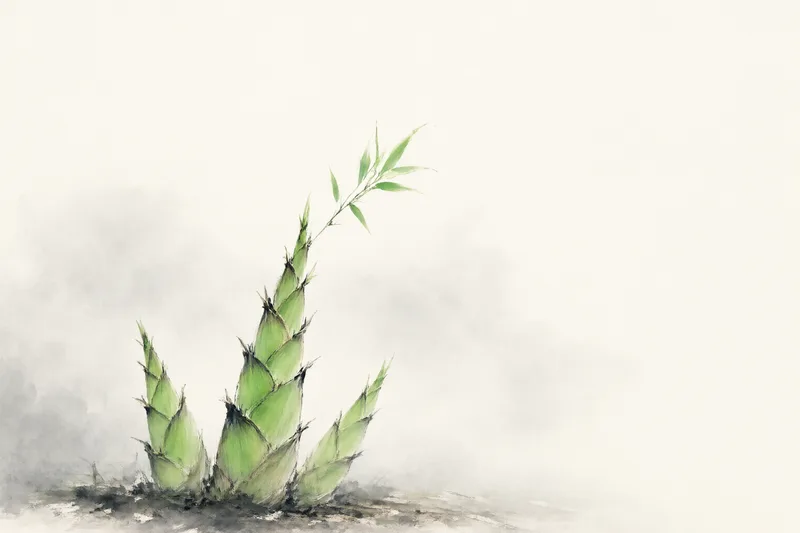
A peach tree in my yard stood bare all winter. Then, in the space of ten days in early spring, it leafed out, flowered, and dropped petals. Nobody fed it. Nobody told it to hurry. It did what Wood does: it grew, upward and outward, the way it was always going to.
Wood is the element of spring. It is the green that returns to the hills, the east wind, the phase of things beginning. In the five-element system it sits at the head of the generating cycle, the first push after the stillness of winter, and it carries the whole personality of growth with it: ambition, initiative, a refusal to stay small.
Here is what the Wood element actually governs, from season to body to temperament, and what it means when yours runs hot or runs low.
The element of the beginning
Every element carries a full set of correspondences, and Wood’s cluster is the most visible of them all.
Spring is its season. East is its direction, where the sun comes up. Green is its color, the tint of new leaves and young shoots. Its climate is wind, which bends around obstacles instead of pushing through them. In the language of the system, Wood is the energy that rises.
The two Chinese characters for the Wood phase are worth knowing because they split it in half. 甲 (jiǎ) is Yang Wood, the trunk of a tree: straight, tough, built to stand. 乙 (yǐ) is Yin Wood, the vine and the flower: flexible, graceful, able to climb. Most people are a mix of both, which is why you can be stubborn as a trunk at work and pliable as a vine with people you trust.
Wood does not wait to be ready. It grows first and hardens later. That single quality explains more about Wood people than any other sentence in this article.
What a Wood person looks like
Physically, classical texts describe the Wood type as tall and slender, with long limbs, long fingers, and a straight back. The skin often carries a greenish or pale undertone. None of this is a hard rule. It is a tendency, the way certain dogs herd and certain cats ignore you. Tendencies matter, but they are not verdicts.
Temperament is where Wood becomes unmistakable. A Wood person:
- Starts projects before the plan is complete, because waiting feels like dying
- Measures time in forward motion, not in hours
- Hates being told what to do, and hates rules with no visible purpose
- Plans ten years ahead and feels a physical ache when the present blocks the path
- Is generous with ideas and protective of the people who carry them
The virtue attached to Wood in Chinese thought is ren (仁), which translates roughly as benevolence or human-heartedness. Wood people are often the ones who see a version of the future and want to build it for everyone, not just for themselves. They are builders by instinct.
The shadow side is just as consistent. Wood can be rigid, impatient, and blind to the fact that other people move at other speeds. The same drive that plants a forest can trample the seedlings someone else was tending.
Wood in the body: the liver meridian
In Chinese medicine, each element is anchored to an organ pair. Wood anchors to the liver (肝 gān) and the gallbladder (胆 dǎn).
The liver is the organ of smooth flow. Its job in the traditional system is to keep qi moving freely through the body, like a stream that must not freeze or flood. It stores blood during rest and releases it during activity. It governs the tendons, which is why Wood imbalance shows up as tightness, stiffness, and that specific ache in the neck and shoulders that never quite goes away.
The liver opens into the eyes. Dry eyes, tired eyes, and blurry vision after long screen time are all read through the Wood lens. So are the sides of the body, which follow the liver channel’s path.
The emotion of Wood is anger. This is the piece most people recognize in themselves: the flash of heat that rises when a plan meets resistance, the irritation that builds when someone moves too slowly. In the traditional view, anger is not the enemy of the liver. Suppressed anger is. The healthy Wood emotion is the ability to push back cleanly and then let it go. Stored anger is a dam across the stream.
Spring is when the liver does its heaviest work. The season asks the body to wake up the way the peach tree does, and a liver still carrying winter’s backlog shows up as springtime irritability, spring headaches, and that restless feeling of wanting to start something with no idea what.
Where Wood sits in the cycle
Wood holds a specific position in the five-element wheel, and that position explains its whole personality.
In the generating cycle, Wood is fed by Water. Deep water, stillness, and winter’s storage all become the sap that Wood rises on. This is why Wood people often have a hidden well of patience underneath their restlessness: the water is there, even when the surface is all motion.
Wood, in turn, feeds Fire. It is fuel. The idea that Wood produces is the very thing that catches, lights up, and becomes visible to the world. A Wood person without a Fire outlet becomes a pile of kindling with no match. Give them a stage, a team, a goal worth burning for, and they come alive.
In the controlling cycle, Wood is restrained by Metal. Metal chops and prunes, and every Wood person eventually meets their Metal: the editor, the accountant, the regulator who says no. Wood needs that friction to avoid becoming a thicket. Metal without Wood is a blade with nothing to cut.
Wood, for its part, controls Earth. It holds the soil, breaks the ground, and gives Earth something to structure around. In relationship terms this is the dynamic of the visionary and the stable one, which is why Wood and Earth pairings are so common and so often described as love-hate.
When Wood runs too strong
Excess Wood is easy to spot because it announces itself loudly.
The signs: impatience that borders on contempt, a temper that flares over small delays, headaches that sit behind the eyes, muscle tension that massage only dulls, and a persistent feeling that everything would be fine if everyone else would just move faster. Wood overgrown looks like a forest that no one has thinned. Every path is overgrown, every branch competes for light, and nothing can breathe.
The emotional signature is a short fuse. If you have been snapping at slow-moving people all week, your Wood is likely running hot. The traditional advice is not to suppress the anger but to move it. The liver likes motion. A fast walk, a climb, a session of clearing physical clutter all release what the Wood emotion has stored.
When Wood runs too low
Deficient Wood is quieter and easier to miss, because it looks like ordinary fatigue.
The signs: difficulty starting anything, a project list that stays static for months, procrastination that has stopped feeling guilty and started feeling permanent, and a sense of being stuck that no amount of planning resolves. Wood depleted looks like a tree in permanent drought. The trunk stands, but nothing new comes out.
Low Wood often appears in people who have been over-managed, over-criticized, or cut down one time too many. The Metal got too heavy. The response is usually not to push harder, which only proves the incapacity, but to restore the Water. Rest, sleep, time in quiet, and a single small project with a visible finish line will slowly bring the sap back.
Bringing Wood back to balance
Balance for Wood is not calm. Calm is the goal of Water. Balance for Wood is the right amount of forward motion: enough to grow, not so much that you trample.
A few practices that work, drawn from the traditional system and easy to test in a normal week:
Move early. Morning movement follows the Wood principle of the day’s growth starting at dawn. Even a twenty-minute walk changes the quality of the whole day.
Eat green, and eat for the liver. Leafy greens, sprouts, and anything that grows fast align with Wood. Bitter flavors, which the liver channel likes, are a smaller add that works.
Give anger a channel with a time limit. When you feel the flash, walk it out before you speak. The walk is not avoidance. It is the Wood emotion moving through the body the way it is supposed to.
Keep one clear direction. Wood gets sick when it branches in every direction. One goal, written down, with a visible first step, is worth more than a notebook of plans. A peach tree does not plan its blossoms. It has one trunk and it grows.
Rest the eyes. Because the liver opens into the eyes, screen exhaustion is Wood exhaustion. The 20-20-20 rule, a few minutes of looking at actual green, or simply closing your eyes for a minute reads as mercy to the liver channel.
Seasonally, spring is the Wood renewal window. This is the time to clear the space, start the thing you have been postponing, and let the morning light in earlier. The body is designed to follow the season, and the season of Wood is built for beginnings.
Common questions
How do I know if my dominant element is Wood? The fastest way is a short personality quiz. In five-element terms, Wood people tend to start things before they are ready, hate being boxed in, and measure their week by what they moved forward. A full chart reading confirms it from your birth date and time.
What body parts does the Wood element govern? The liver and the gallbladder, with the eyes, the tendons, and the sides of the body closely tied in. In Chinese medicine the liver is the organ of smooth flow, which is why Wood imbalance often shows up as irritability, eye strain, or tension in the neck and shoulders.
What happens when Wood is out of balance? Too much Wood shows as impatience, chronic anger, headaches, and a need to control outcomes. Too little shows as low motivation, indecision, and a feeling of being stuck. Both read as a spring that has gone wrong, either overgrown or not growing at all.
What is the best way to balance Wood in daily life? Spring habits that honor the season: wake early, move your body in the morning, eat green vegetables, and give your mind a clear direction to grow toward. When anger spikes, walk it out before you speak. The liver responds to motion and to letting go.
The Wood element is not a personality label. It is a description of how growth works, and every person carries some amount of it. When you learn to read it, you stop fighting your own natural motion. You start your project when it is time to start. You move when you are stuck. You let the peach tree be a peach tree.
If you want to know where your own five elements sit, our Five Elements Quiz takes about two minutes and returns your dominant and secondary elements. For the deeper layer, the Five Elements Personality Report maps your chart against each element’s strengths and shadow sides, with a section on which habits keep your Wood in its natural rhythm.
New to the five elements? The Complete Guide to the Five Elements explains the generating and controlling cycles in full.