Fire Element: Passion, Summer, Finding Balance
Why the Fire element rules summer, the heart meridian, and joy. How to spot a Fire person, what imbalance looks like, and how to restore your balance.
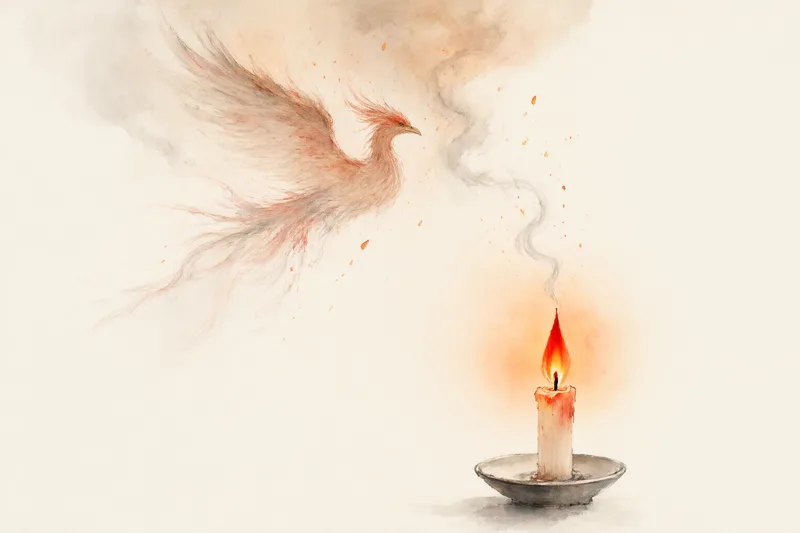
The power went out during a heat wave last August, and I lit one candle on the kitchen table. The room had been all black window and trapped heat. Within a minute it had a center. A flame that small still reached every corner, and everyone drifted toward it without deciding to. That is Fire in one image: it takes what was stored and turns it into something the whole room can see.
Fire is the element of summer. It is the south, the red of ripe fruit and heated metal, the phase where growth stops reaching up and starts shining out. Wood spent the spring pushing toward the sky. Fire spends the summer turning whatever Wood gathered into light. In the five-element system it is the most visible element, which is also why it is the hardest to disguise.
Here is what the Fire element actually governs, from season to body to temperament, and what it looks like when yours burns too hot or too low.
The element at full brightness
Every element arrives with a full set of correspondences. Fire’s cluster is the loudest of them.
Summer is its season, the peak of the year’s heat. South is its direction, where the sun stands highest at noon. Red is its color, the shade of blood and ember and ripe chili. Its climate is heat, which is why Fire and summer have always been described in the same breath. In the language of the system, Fire is the energy that radiates. It no longer climbs the way Wood does. It shines.
The two Chinese characters for the Fire phase split it cleanly. 丙 (bǐng) is Yang Fire, the sun: broad, direct, impossible to ignore. It rules the daytime and the part of you that walks into a room and changes its temperature. 丁 (dīng) is Yin Fire, the lamp flame and the candle: smaller, steadier, warm at close range. It rules the evening and the part of you that keeps one person company through a hard night. A balanced person has access to both, sun at work and candle at home.
The virtue bound to Fire in Chinese thought is li (礼), usually translated as propriety or ritual. That translation undersells it. Li is what lets a group of people warm one another on purpose: manners, ceremony, the right word at the right moment. Wood builds. Water plans. Fire makes the room feel human.
What a Fire person looks like
Classical texts describe the Fire type with a ruddy face, quick gestures, and a voice that arrives before the thought is finished. None of it is a hard rule. It is a tendency, the way fire itself is a tendency. The point is visibility. A Fire person cannot do small, and cannot do nothing.
A Fire person:
- Talks fast and laughs louder than the conversation requires
- Feels cold rooms as personal insults and silence as abandonment
- Performs for whoever is watching, including strangers in an elevator
- Gets an idea and has to tell someone immediately or it stops being real
- Burns out in public and recovers only in private
The gift of Fire is joy, but its specific form is shared joy. Wood people are glad in private when the project moves. Fire people need the laughter to be mutual. That is why li matters so much to them. Ritual is the container that lets enthusiasm spread without scorching anyone.
The shadow side is the heat itself. Fire can be theatrical, exhausting, and blind to its own glare. It fills every silence because silence feels like failure. It makes everything a performance, then resents the audience it demanded. The same warmth that gathers a room can, unchecked, drive everyone out of it.
Fire in the body: the heart meridian
In Chinese medicine each element anchors to an organ pair. Fire anchors to the heart (心 xīn) and the small intestine (小肠 xiǎocháng).
The heart is the emperor of the organs. It governs the blood and the vessels, and it houses the shen (神), the spirit that the other organs answer to. When the heart is calm, thought is clear and sleep comes easily. When the Fire in the heart is disturbed, the mind races and the nights shorten.
The heart opens into the tongue. Its luster shows on the face, which is why flushed cheeks and a dry mouth get read through the Fire lens. Its fluid is sweat, which is why summer and exertion tax it most. Because Fire rules the blood, the pulse is its monitor, and a racing, overflowing pulse is a heart Fire reading.
The emotion of Fire is joy. This is the least understood piece, because joy sounds harmless. In the traditional view the problem is not joy but excess joy. The feeling that injures the heart is joy that has overrun its banks: excitement that cannot sleep, enthusiasm that curdles into agitation, a happiness that is really a buzz. The paired feeling that settles it is fear, which is why the old teaching says dread overcomes manic delight. A healthy heart can hold both and let each pass.
Summer is when the heart works hardest. The season is Fire’s own, the days at their longest, and a heart already overheated shows up as midsummer insomnia, racing thoughts at two in the morning, and a tongue that keeps developing sores.
Where Fire sits in the cycle
Fire holds a defined place in the five-element wheel, and the place explains its personality.
In the generating cycle Fire is fed by Wood. This is the debt the flame owes the tree, and every Fire person carries it. The ideas, the plans, the slow green growth of spring all become the fuel that summer burns. Fire without Wood is a bonfire with nothing left to feed it, bright for an hour and then gone.
Fire, in turn, feeds Earth. This is the least romantic fact in the system and one of the most useful. Fire consumes, and what it leaves behind is ash, and ash becomes soil. 火生土. Every burst of brilliance eventually settles into something that can grow again. The wildfire that looks like pure destruction is, over the long cycle, feeding the ground it ran across.
In the controlling cycle Water checks Fire. This is the pairing that keeps the system from combusting: depth against brightness, stillness against motion. When Fire runs away, Water is the corrective. That is why the traditional remedies for an overheated heart are watery ones: rest, night, and the color black.
Fire, for its part, controls Metal. It melts and shapes it. The blade that Wood feared goes into the furnace and comes out a tool. This is Fire’s role in the cycle, the transformer, the force that makes hard things soft enough to become useful.
When Fire runs too strong
Excess Fire announces itself and then refuses to leave.
The signs: a mind that will not switch off, sleep that stays shallow no matter how tired you are, a tongue dotted with small sores, a face that flushes at nothing, a pulse that feels like it is running a race you never entered. Emotionally it is a low buzz, not anger but agitation, joy that has turned jumpy. You laugh at everything and rest at nothing. People describe you as a lot, and they mean it fondly and also as a warning.
The traditional advice is not to smother the flame but to give it a season of water. Cool down the body and the mind follows. Longer exhales, cooler rooms, earlier nights, and a few minutes of genuine quiet. The heart, like the emperor it is modeled on, rules best when it is not constantly shouted at.
When Fire runs too low
Deficient Fire is quieter and easier to misread, because it looks like ordinary gloom.
The signs: nothing lights you up, and you have started to believe nothing will. Enthusiasm feels like a performance you no longer have the energy to give. You are cold when others are warm, tired when others are awake, and you have stopped joining the conversation because joining requires a spark you cannot find. Fire depleted looks like a hearth with no flame: the structure is intact, the room is just not warm.
Low Fire often follows a period of being burned. A betrayal, a public humiliation, a long stretch of performing for people who did not care. The heart learns that shining costs too much and turns itself down. The response is rarely to force the brightness, which only proves the cost. It is to rebuild the fire from a single honest flame: one small thing that genuinely delights you, done without an audience, until the joy remembers it is allowed.
Bringing Fire back to balance
Balance for Fire is not coldness. Coldness is the temporary medicine, not the goal. The goal is a fire that holds its shape: bright enough to warm the room, contained enough that no one has to step back.
Practices that work, drawn from the traditional system and easy to test in a normal week:
Honor the heart’s hour. The heart meridian peaks between 11 a.m. and 1 p.m. A short rest at midday, even ten minutes with your eyes closed, is the highest-value habit for a Fire-dominant person. The heart does its heaviest work while the sun is highest.
Cool from the outside in. Cool water on the wrists and the back of the neck, a walk in the shade, a room with the lights turned low. Fire people run hot in every sense, and the body leads the mind.
Breathe out longer than you breathe in. A long exhale is the oldest cooling switch in the book. When the buzz starts, slow the breath and the heart rate follows.
Eat bitter, and eat cooling. Bitter flavor enters the heart channel. Green tea, bitter greens, watermelon, and cucumber all read as mercy to an overheated Fire. Chilies and heavy red meat add fuel.
Take the audience away. Fire people sharpen when watched. Schedule intervals with no one watching: a walk alone, a page of writing no one will read, a meal eaten without a phone. The flame needs to practice being a candle, not a bonfire.
Let joy have a shape. Because Fire’s virtue is li, ritual steadies it. A fixed dinner hour, a greeting you actually mean, a small ceremony for the end of the day. Enthusiasm without a container spills. Enthusiasm with one warms.
Seasonally, summer is Fire’s peak, which is exactly when it needs the most care, the way the busiest organ needs the most rest. The body follows the season. The season of Fire rewards the person who can be bright without being scorching.
Common questions
How do I know if my dominant element is Fire? The fastest way is a short personality quiz. In five-element terms, Fire people tend to talk fast, need an audience, feel cold rooms as personal insults, and measure their week by moments of shared joy rather than by completed tasks. A full chart reading confirms it from your birth date and time.
What body parts does the Fire element govern? The heart and the small intestine, with the tongue, the blood vessels, and the complexion closely tied in. In Chinese medicine the heart houses the shen, the spirit, which is why Fire imbalance often shows up as racing thoughts, insomnia, flushed cheeks, or a dry mouth.
What happens when Fire is out of balance? Too much Fire shows as agitation, shallow sleep, tongue sores, and a buzz that will not settle. Too little shows as low enthusiasm, feeling cold, and a joy that has stopped arriving. Both read as a summer gone wrong, either scorching or not arriving at all.
What is the best way to balance Fire in daily life? Summer habits that honor the season: rest at midday, cool the body from the outside in, eat bitter and cooling foods, and give the mind intervals of quiet. When the buzz rises, breathe out longer than you breathe in. The heart responds to coolness and to rest.
The Fire element is not a personality verdict. It is a description of how visibility works, and every person carries some amount of it. When you read it honestly, you stop apologizing for your warmth and stop letting it run the room. You learn when to shine and when to bank the coals, which is the whole art of being on fire without being consumed.
If you want to know where your own five elements sit, our Five Elements Quiz takes about two minutes and returns your dominant and secondary elements. For the deeper layer, the Five Elements Personality Report maps your chart against each element’s strengths and shadow sides, with a section on which habits keep your Fire at a steady burn.
New to the five elements? The Complete Guide to the Five Elements explains the generating and controlling cycles in full. Fire begins where Wood ends, so the Wood Element guide covers the spring that feeds this flame.