Yin and Yang: Which Is Which and What the Colors Mean
Black is yin, white is yang. Here is the full checklist for telling them apart by light, temperature, time, and direction, and why the same thing is both.
Everyone who looks closely at the black and white circle asks the same two questions. Which half is which, and what do the colors mean.
The first has a clean answer. Black is yin, white is yang. The second is where most explanations wander off, because the colors carry less information than people expect, and the part of the tradition that sorts things into yin and yang carries much more.
Black is yin. That part is not a convention
It would be reasonable to assume the colors are agreed on the way a red light means stop. They are not. They come out of the characters, and the characters come out of a hillside.
Both 陰 (yīn) and 陽 (yáng) are built from the same component: 阝, a compressed form of 阜, which means a mound or an earthen hill. What sits beside that component is the part that differs. The old form of yin carried 侌, a character made of 今 (now) and 云 (cloud), meaning overcast. The old form of yang carried 昜, which shows 日 (sun) with rays coming down.
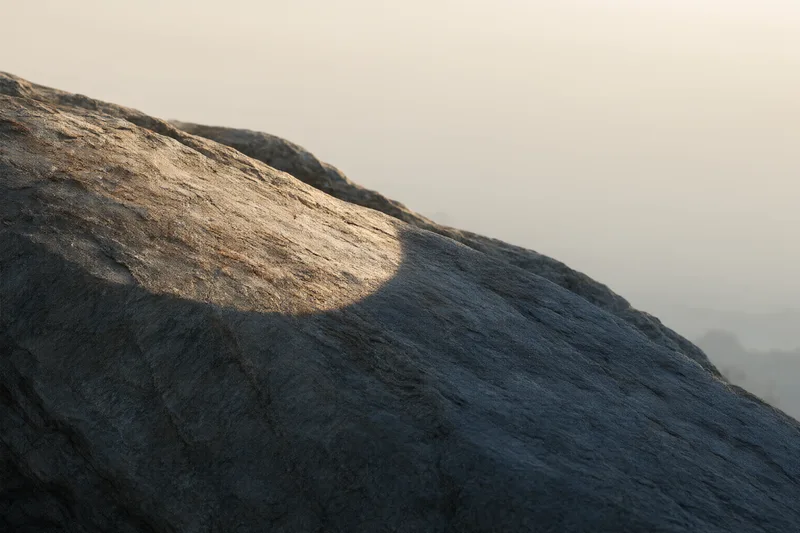
So the two words began as descriptions of a slope. The Han dynasty dictionary Shuowen Jiezi defines 陰 as “dark; north of a mountain, south of a river” and 陽 as “high and bright.” A mountain in the northern hemisphere catches sun on its south face and shadow on its north face. One hill, two sides. The characters name the sides, not two kinds of matter.
The earliest appearance of the two words together is in the Shijing, the Book of Songs, in a passage from around the 9th century BCE describing a survey of terrain: 相其陰陽, “he inspected its shady and sunny sides.” The phrase is about land, not cosmology. A duke was choosing where to settle.
This is why black is yin. Black is what you see when there is no light on the slope. The color assignment is downstream of the sunlight, not the other way around. Once you know that, the symbol stops looking like two abstract substances and starts looking like a record of one very ordinary observation.
The list goes well past black and white
Color is one pair among many, and a rough one. The tradition sorts by dimension, and the same underlying contrast shows up in each of them.
| Dimension | Yin | Yang |
|---|---|---|
| Light | Shadow, dim, covered | Lit, bright, exposed |
| Temperature | Cold, cool | Hot, warm |
| Season | Winter | Summer |
| Time | Night | Day |
| Slope | North-facing | South-facing |
| Movement | Still, slow, sinking | Moving, fast, rising |
| Structure | Soft, yielding, loose | Hard, firm, taut |
| Density | Open, diffuse, empty | Packed, full, dense |
| Sound | Quiet, low, muffled | Loud, high, sharp |
| Water | Deep still pool | Running stream |
| Space | Enclosed, private, interior | Open, public, exterior |
| Attention | Receiving, listening | Directing, acting |
| Company | Alone, withdrawn | Together, engaged |
| Body | Rest, repair, sleep | Work, output, sweat |
| Mind | Diffuse, associative | Focused, sequential |
| Cycle stage | Ripening, storing | Sprouting, expanding |
Sixteen rows, and it could run longer. Notice that several of them are not clean opposites at all. A deep still pool and a running stream are both water. Alone and together are both states a person moves through daily. The table is not a set of enemies facing off. It is a set of phases.
That matters for how you read it. If you scan this list looking for which column is the good one, you will not find it, because the columns are not ranked. They are two ends of a cycle that everything passes through, including you, every single day. You wake (yang), you tire (yin), you sleep (yin), you wake again (yang).
Why the same thing is often both
Here is where most people get stuck, and where the honest answer lives.
Ask whether water is yin or yang and you have asked an incomplete question. Water against fire is yin. Water against a frozen lake is yang, since liquid moves and ice does not. Water in a still well against water in a waterfall is yin. Same substance, three answers, no contradiction.
A kitchen is yang against a bedroom and yin against a gym. A mountain is yang on its south face and yin on its north face. Your voice on a phone call is yin against a thunderclap and yang against a whisper. The label attaches to a comparison, not to a thing.
This is not a loophole in the system. It is the system. The Xici Zhuan, the Great Commentary attached to the I Ching, has the line that every Chinese philosophy course eventually quotes: 一陰一陽之謂道, “one yin, one yang, this is called the Dao.” Read it carefully. The Dao is not yin and it is not yang. It is the one-then-the-other, the alternation itself. The Song dynasty scholar Cheng Yi made the point explicitly when he wrote that the Dao is not yin and yang, but rather what makes them alternate.
So when someone tells you a thing “is yin,” the unspoken half of the sentence is always “compared to something else.” That is not vagueness. It is the level of precision the framework actually operates at, and pretending otherwise is how the whole thing turns into a deck of labels with no meaning left in them.
Three questions that settle it
When you want to place something and no table row covers it, run three checks. Answer each in one word.
Is it receiving or producing? A window receives light. A lamp produces it. Receiving leans yin, producing leans yang.
Is it settling or moving? A stone bench settles. A staircase moves people through. Stillness leans yin, motion leans yang.
Is it contracting or expanding? A closed door contracts a space. An open floor plan expands one. Contraction leans yin, expansion leans yang.
Most of the time the three answers agree and you are done. When they disagree, you have found something genuinely mixed, and the tiebreaker is function: what does this thing mostly do in your life? A chair is motionless, which sounds yin, but its whole job is to hold a body at rest, which is even more yin, so the chair is yin and nobody who has ever fallen asleep in one will argue.
A ceiling fan is the interesting case. It is a machine, which reads yang, but it moves air to cool a room, and cooling is yin, and it is usually off at night, when the room is yin anyway. The fan is yang in mechanism and yin in purpose. Run it in summer and you have doubled down on cooling when the season already supplies it. This is exactly the kind of small reading the framework was built to produce.
The colors are not a morality play
Almost every Western reader arrives at the symbol carrying a color code that is not in it. In that code black is death, danger, villainy, and white is purity, safety, the good guys. The taijitu looks like it should confirm all of that, and it does not.
Chinese color associations run on a different track. White is the traditional color of mourning in China, not black. A Chinese funeral is white. A Chinese wedding is red. Neither association matches the Western one, and neither maps onto good or evil. The colors in the symbol are, as the characters showed, about sunlight on a slope.
There is a second confusion worth clearing, because it shows up constantly in feng shui writing. The black and white of the taijitu is not the same system as the five colors of the five elements. That system assigns green to wood, red to fire, yellow to earth, white to metal, and black to water. White lands on metal and black lands on water, and both are simply directions and seasons: white is west and autumn, black is north and winter. Two separate schemes, one borrowing two colors from the other.
If you want the color system that actually governs rooms, that is its own subject, and we cover it room by room in the feng shui color guide.
The diagram is younger than the idea
The concept is old. The picture you are picturing is not.
Yin and yang as a way of sorting the world runs back through the Shijing, the Daodejing (chapter 42: 萬物負陰而抱陽, “the ten thousand things carry yin on their backs and hold yang in their arms”), and the medical canon. The black and white fish shape is a much later arrival. The earliest clear textual record of it comes from the early Ming dynasty, in Zhao Huiqian’s Liushu Benyi, where it appears under the name “the natural Hetu of heaven and earth.” Late in the Ming, Zhao Zhongquan’s Daoxue Zhengtong gave it the name that stuck, “the ancient taiji diagram.”
The diagram people usually confuse it with is older and completely different. Zhou Dunyi, the Northern Song philosopher, wrote an Explanation of the Diagram of the Supreme Ultimate, and his diagram was five stacked circles showing the sequence from the undifferentiated to the ten thousand things. No fish. No dots. Just circles. Zhu Xi promoted it heavily, and it spread through the Yuan, Ming, and Qing, which is probably why the two get merged in popular memory.
Which means the very common question of which way the symbol should face has no classical answer, because there is no classical rule to consult. Both a clockwise and a counterclockwise version are in circulation, and the difference between them is not a doctrinal one. What the curve does carry is motion. It is drawn as an S because the two halves are trading places, and a diagram of an exchange should not look still. That is the part worth keeping, and it survives whichever way you rotate the picture.
Where this changes an actual decision
Three places the answer stops being academic.
Choosing a wall color
A north-facing room in a northern climate gets little direct sun for half the year, which makes it yin before you touch it. Painting it deep blue or charcoal adds yin to a room that is already losing the argument with winter. The same paint in a south-facing room with a wall of glass behaves differently, because the room has yang to spare. The color is the same. The reading is not.
Laying out your week
If your calendar is wall-to-wall yang (calls, launches, travel, decisions) and you wonder why Friday feels like walking through sand, the framework has a boring and correct answer: nothing in the schedule is yin. Recovery is not a reward for finishing. In this model it is the other half of the cycle, and a cycle with one half missing is not a busy cycle, it is a broken one.
Reading your own body clock
The traditional organ clock assigns two-hour windows to each meridian across the day, and the pattern of the windows follows the same rise and fall. The 3am waking that sends so many people searching is a yin-hour symptom in a yang-paced life. We go through the full clock and what each window governs in the Chinese body clock article.
The short version
Black is yin because the north face of a hill is dark. White is yang because the south face is lit. Everything else in the table is that same observation applied to temperature, sound, season, and mood.
And when the labels seem to move, they are not being slippery. They are doing the one thing the framework was designed to do: describing a pair rather than a thing. Name the second half of the comparison and the answer appears. Leave it unnamed and the question was never answerable in the first place.
FAQ
Which is yin, black or white?
Black is yin and white is yang. The colors are not a convention like a stop light. Black is the shaded half, and the character for yin (陰) originally described the north face of a hill, the side the sun does not reach. White is the lit half, and yang (陽) described the south face.
Is yin bad and yang good?
No. Neither half of the symbol is morally better. The tradition treats them as two phases of one cycle, the way night and day are two phases of one rotation. Reading black as evil and white as good is a Western color code being laid over a Chinese diagram that never carried it.
Is water yin or yang?
Both, depending on what you compare it to. Still water against fire is yin. A running stream against a frozen lake is yang. Yin and yang describe a relationship between two things, not a fixed property stored inside one thing, which is why the question only has an answer once you name the second term.
What do the two dots inside the symbol mean?
The black dot inside the white half and the white dot inside the black half say that nothing is purely one or the other. Every yang phase carries the seed of yin, and every yin phase carries the seed of yang. In practice it means a restful room with no life in it stops being restful, and a productive routine with no rest in it stops being productive.
Is the yin yang symbol a religious sign?
It predates organized Daoism as a concept, and the black and white circle you see today is a much later drawing. The idea appears across Confucian, Daoist, and medical texts, and the diagram as people now recognize it only became standard in the Ming dynasty. It works as a philosophical shorthand rather than a devotional object.
What to read next
- Yin and yang explained covers what the symbol means and why it is not a story about good versus evil
- Yin and yang in interior design reads each room in a house and shows which way it already leans
- The five elements takes the same logic and splits it into five phases instead of two
- The I Ching builds sixty-four hexagrams out of nothing but yin and yang lines