I Ching vs Tarot: Which Oracle Fits Your Question?
The I Ching and tarot answer different questions. A structural comparison of both systems, plus a plain test for choosing the one your situation needs.
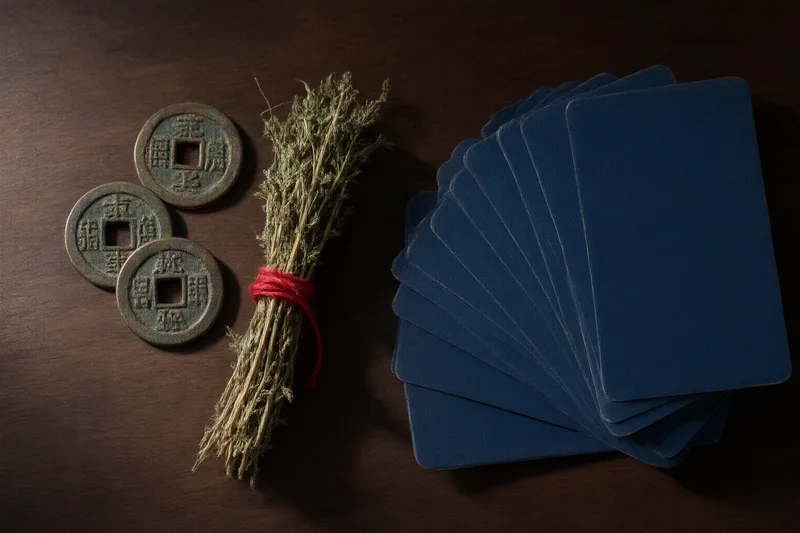
Two decks sit on the same shelf in most homes that own either one. A tarot deck in a cloth bag. Three Chinese coins, or a bundle of yarrow stalks, in a small box. The question that follows is almost always the same: which one should I use?
They are not two versions of a single tool. An I Ching reading and a tarot reading are different instruments, built centuries apart, for different jobs. One is a closed book of situations. The other is an open deck of images. Choose the wrong one and you may get a beautiful answer to a question you did not need answered.
The comparison below is structural. It looks at what each system does with a question, where the limits sit, and how to tell which one your situation calls for.
The short answer
| If your question is about | Use |
|---|---|
| Timing, direction, strategy, the shape a situation is taking | I Ching |
| Feelings, relationships, inner conflict, how a person is showing up | Tarot |
| A fixed event with a date attached | Neither, see below |
| A decision you want someone else to make | Neither |
| Someone else’s private choice | Neither |
The first two rows are the useful ones. Most of the rest of this article explains why they fall where they do.
Two ancestries, three thousand years apart
The I Ching is the older text by a wide margin. Its core, the Zhouyi, took shape around 1000 BCE in the early Zhou dynasty. The system rests on 64 hexagrams, each built from six lines that are either whole or broken. Tradition credits King Wen with the arrangement and the Duke of Zhou with the line texts. The Ten Wings, the commentaries that turn a divination manual into a philosophy book, were added later, during the Warring States period. By the Han dynasty, roughly the second century BCE, the book had entered the canon of the Five Classics. It has been read continuously ever since.
Tarot’s history is shorter, and more often garbled. The cards first appear in northern Italy in the 1440s as a trick-taking game called tarocchi. The 78-card structure was there from the start: 22 trumps and four suits of 14. The game spread across Europe and stayed a game for three centuries. None of the surviving fifteenth-century documents describe the cards as an oracle.
Divination entered in 1781, when the French scholar Court de Gébelin announced that the cards were the surviving Book of Thoth from ancient Egypt. The claim was wrong when he made it and remains wrong. It also caught on. Within a few years Jean-Baptiste Alliette, writing as Etteilla, published a systematic method for reading the cards, and the practice moved from Paris salons into a tradition of its own. The modern illustrated deck arrived in 1909, when Arthur Edward Waite and the artist Pamela Colman Smith published the Rider-Waite deck with a scene drawn on every card, minor suits included. That deck is the reason most English-speaking readers treat tarot as an image system rather than a list of card meanings.
Why does the history matter? Because a comparison that calls both “ancient wisdom” gets the tarot wrong in a way that changes how you use it. Tarot is a young oracle built on an older game, and it knows it. The I Ching is an old book that was used for divination before it was used for anything else. Neither fact makes one system better. Both facts tell you what to expect.
Six lines against seventy-eight cards
Structure first, because structure decides what kind of answer a system can give.
An I Ching cast produces six lines, built from the bottom up. Each line comes out as one of four numbers:
| Number | Line | Behavior |
|---|---|---|
| 6 | Old yin | Changes into yang |
| 7 | Young yang | Stays |
| 8 | Young yin | Stays |
| 9 | Old yang | Changes into yin |
Six lines with four possible states each gives 4,096 possible casts. Any 6 or 9 flips, and the flipped lines form a second hexagram, the transformed one. Ignore the changing lines and you are left with 64 primary hexagrams.
Tarot has 78 cards. Twenty-two are Major Arcana, the named figures and scenes from the Fool to the World. Fifty-six are Minor Arcana, divided into four suits of 14, numbered ace through ten plus four court cards. A three-card draw has 456,456 ordered combinations if you draw without replacement. A ten-card spread has more arrangements than you would ever need to think about.
The numbers look lopsided, and they measure different things. The I Ching’s 4,096 casts are all indexed to a fixed text. Each one has a name, a judgment, an image, six line texts, and a commentarial tradition that runs for two thousand years. Nothing at the level of vocabulary is left for the reader to invent. Tarot’s space is combinatorial because each card’s meaning is partly open, and the spread adds a second layer of position meaning on top of the card. The deck gives the reader more room. The book gives less room and more depth per position.
That trade-off runs through every other difference between them.
A situation or a person
A hexagram describes a configuration of forces, a moment with you inside it. Look down the list of 64 names: The Creative, The Receptive, Difficulty at the Beginning, Waiting, Conflict, Holding Together, Modesty, Enthusiasm, Following, Work on What Has Been Spoiled, Return. Not one of them is a person. The nearest thing to a figure is the superior man of the line texts, and he is an example of conduct rather than a character. The I Ching has no card for your mother. It has a hexagram for the field you and your mother are standing in.
Tarot is the opposite. The Major Arcana are figures: the Fool, the Emperor, the Hermit, the Tower, the Star. The Minor Arcana are scenes of ordinary life, a person carrying ten swords, five people fighting over five swords, a woman seated between two cups. The deck is populated. It reads people and the weather between them.
This difference decides a lot of question matching. If your question begins “what is he feeling”, tarot has the vocabulary. The I Ching will answer with the shape of the situation you are both in, which may be more useful, but it will not tell you what is in his chest. If your question is “should I take this job or that one”, the I Ching has a structure built for it. Tarot can describe the emotional weather around each option, and it will tend to describe the people involved rather than the circumstances.
A closed text against an open image
The I Ching’s text is fixed, and this is both its strength and its frustration. Two readers who draw hexagram 18 are looking at the same words: Work on What Has Been Spoiled. They may disagree about what those words mean for a divorce or a stalled business. They cannot disagree about what the oracle said. The argument stays anchored to a text.
Tarot meaning is more distributed. The Rider-Waite-Smith images set a common vocabulary in the English-speaking world, but a Marseille deck, a Thoth deck, and any of the hundreds of contemporary decks use different pictures for the same card. Even within one deck, meaning shifts with position, orientation, and the cards next to it. This is what readers mean when they call tarot intuitive. It is also the system’s main weakness, because an open image invites you to see what you already believe.
Neither method removes projection. A fixed text can be read selectively; people quote the line that comforts them and skip the one that does not. A picture can be read as confirmation; a card that could mean caution or opportunity will mean whichever the reader needs. The honest formulation is not that one system is objective. It is that the I Ching puts its ambiguity in the interpretation of words, and tarot puts its ambiguity in the reading of images. If you are the kind of person who argues with a text, the I Ching suits you. If you think in pictures, tarot will feel closer to your mind.
The time axis
This is the sharpest practical difference, and most comparisons skip it.
The I Ching builds movement into the mechanics. A changing line is not a feature you add. It is one of four possible states of a line, and its whole function is to flip. Half of the possible line states are changing states, so a cast with no changing lines is less common than one might guess. The transformed hexagram shows the trajectory: where the current configuration is heading if nothing intervenes. Direction is part of the answer’s grammar. When people say the I Ching is good for strategy, this is the mechanical reason.
Tarot has no equivalent inside the deck. If you want time in a tarot reading, you put it into the layout. The three-card past, present, and future spread does it. The ten-card Celtic Cross does it with an outcome position. A timeline spread does it explicitly. The positions carry the time, not the cards. A single-card pull is a snapshot with no momentum, and any sense of direction comes from the reader.
For “what should I do next” and “which way is this going”, the I Ching is structurally better at the question. For “what is the emotional shape of this moment”, tarot is better, because the I Ching will keep telling you about circumstances when you asked about feelings.
Matching the system to the question
Four tests, applied in order.
1. Does the question have a direction? If you are asking whether a situation is growing or exhausting itself, whether to move now or wait, which of two paths has more room in it, use the I Ching. Its answer includes a trajectory by construction.
2. Is the subject a person’s interior? Feelings, motives, the tone of a relationship, how someone is likely to behave when it costs them something. Use tarot. The I Ching will answer, but it will answer about the field rather than the person, and you may spend the reading translating.
3. Do you want a decision or a description? Neither system decides. If you are casting because you want the responsibility taken off your hands, no deck will do that, and the reading will show your evasion. If you want the situation described so you can decide, both work, and the tie breaks on vocabulary.
4. Is the question fixed? “Will I get the job” is a fixed-event question. Neither system has a documented record of answering it, and neither tradition claims to be a forecasting engine. The better question is “what do I need to understand about this application”, and that question has a system that fits.
Those four tests will handle most cases. The awkward ones are questions that mix a person and a situation, such as “will this relationship survive the move”. That question has both an emotional subject and a directional one. My own habit is to ask the I Ching about the move and the tarot about the relationship, as two separate questions on separate days. More on that below.
The same question, read both ways
Take a real-shaped question: you have an offer to move abroad for a job, and you cannot tell whether accepting it is courage or a mistake.
An I Ching reading for that question might give hexagram 5, Xu, Waiting. Clouds above heaven: rain is gathering but has not fallen. The judgment reads, “Waiting. If you are sincere, you have light and success. Perseverance brings good fortune. It furthers one to cross the great water.” The fifth line changes, and it says, “Waiting with food and drink. Perseverance brings good fortune.” The transformed hexagram is 11, Tai, Peace.
Read as guidance for the move, the answer is specific without being a verdict. Waiting is the right posture right now, but waiting is not the same as refusing, and the judgment itself names crossing the great water as favorable. The changing line adds a practical instruction: keep provisions. Do not go hungry while you wait; negotiate the terms, keep savings, do not burn the bridge. The transformed hexagram says the direction is toward opening and exchange, not collapse. Nothing in the reading says yes or no. It says the timing is a wait with supplies, and the trajectory is good.
A tarot three-card draw for the same question might give the Fool, the Five of Swords, and the Ten of Pentacles. The Fool is the clean break and the willingness to start without a map. The Five of Swords is conflict where winning costs more than it should. The Ten of Pentacles is a long foundation, family, property, the thing you build across generations. Read together, they describe a pull toward a fresh start, a warning about the negotiation or the people around it, and an end state that is about stability rather than adventure.
The two readings do not contradict each other. They are not even answering at the same depth. The hexagram told you about timing and transition and gave you one instruction about provisions. The cards told you about the emotional pull, the specific friction to expect, and what the move is really for. If you only cast the I Ching, you would know to wait and stock up. If you only drew cards, you would know the negotiation is where the damage happens. Both are true, and neither is complete.
Using both without fooling yourself
Five rules keep the combination honest.
1. One question, one system, one sitting. Do not cast the hexagram and then pull cards on the same question twenty minutes later because the first answer was not what you wanted. That is not a second opinion. It is shopping.
2. Do not map hexagrams onto cards. There is no traditional correspondence between the 64 hexagrams and the 78 cards. The tables you find online are modern, most of them borrowed from Kabbalistic systems that were themselves invented in the nineteenth century. They can be an interesting personal language. They are not a tradition, and they do not carry the commentarial depth of either source.
3. Give the second system a gap. If you genuinely need both, separate them by at least a day, and change the question. Ask the I Ching about the situation, then ask tarot about the person, or the other way round. Different questions, different instruments.
4. Write the reading down before you interpret it. Record the hexagram numbers, the changing lines, the cards, and the positions first. Interpret afterwards, in a separate paragraph. This is the single best defense against reading your hopes into either system. The I Ching journal method covers the format.
5. If you did not like the answer, the problem is not the system. Casting again until a reading flatters you is bargaining, not consulting. The same applies to drawing more cards.
What neither system can do
Neither oracle predicts fixed events with any reliability. The I Ching’s own text spends its words on conduct: what kind of person to be in this situation. Tarot’s most defensible use is psychological: what you already know and have not said out loud.
Neither replaces medical, legal, or financial advice. If a reading tells you to stop taking a medication, the reading is wrong and you should ignore it. If you are deciding whether to sign a contract, ask a lawyer, then cast if you still want to see the shape of the decision.
Neither gives you access to another person’s private mind. A reading about someone’s feelings describes your relationship with them, filtered through your own knowledge. It is not surveillance, and treating it as surveillance damages the relationship it claims to describe.
The learning curve
The I Ching has 64 hexagrams, which sounds like more than 78 cards until you look at what you have to learn. The text is stable. You can work with a reference table from the first day, and the Wilhelm translation gives you the standard English rendering of every line. Three coins and a free coin casting tool cover the hardware. The hard part is reading the text as a description of a situation rather than a fortune, and that skill improves with practice and with a journal.
Tarot is easier in the first week and harder in the third month. Seventy-eight cards with images feel intuitive immediately, and the Rider-Waite-Smith deck is designed to be read visually. The difficulty comes later, when you notice that your readings have settled into a personal idiom and you can no longer tell whether the cards are speaking or you are. A deck costs money, usually between twenty and forty dollars, and different decks will give you different readings of the same card.
Which to learn first? If you read mostly for decisions, learn the I Ching. Its answers are easier to check against what actually happened, because the transformed hexagram gives you a direction you can compare with the outcome. If you read mostly for people, learn tarot. It has the vocabulary, and no amount of hexagram study will give you a card for a lover’s silence.
Where to start
If you already have a question with a direction in it, the guide to the Book of Changes explains the text, and the coin casting method covers the two ways to produce the lines. If your question is a decision between two live options, the guide to using the I Ching for decisions walks through the two-cast method with a full sample reading. If you have already cast and want a line by line walk through the result, the I Ching Deep Reading ($9.99) covers the primary hexagram, the changing lines, and the transformed hexagram together.
You do not need to choose a side in the I Ching versus tarot argument. You need to know which question you are holding, because the question decides the tool. A situation with a direction wants the book. A person with a mood wants the deck. Ask the wrong one and you will get a reading that is true and useless, which is the most frustrating kind.
Frequently Asked Questions
Is tarot older than the I Ching?
No. The core text of the I Ching took shape around 1000 BCE in the early Zhou dynasty. Playing cards with the tarot structure first appear in northern Italy in the 1440s, as a card game called tarocchi. Its use for divination began in the 1780s, when Court de Gébelin published a claim that the cards were an Egyptian book of wisdom. That claim was false, but the practice built on it survived.
Which is more accurate, the I Ching or tarot?
The question assumes both are trying to do the same thing, and they are not. The I Ching reads the shape and direction of a situation. Tarot reads people, moods, and relational dynamics. Neither system has produced repeatable evidence of beating chance at predicting fixed events. Choose by question type, not by a claim of accuracy.
Can I combine the I Ching and tarot in one reading?
You can, but no traditional system maps hexagrams to cards. The correspondences you find online are modern inventions, often borrowed from Kabbalah. A cleaner method is to keep them separate: one system per question, with a gap of at least a day before asking the other the same thing.
How many possible outcomes does an I Ching reading have?
Each of the six lines can be 6, 7, 8, or 9, which gives 4,096 possible casts. Values 6 and 9 are changing lines, so most casts produce a primary hexagram plus a transformed one. If you set the changing lines aside, there are 64 primary hexagrams.
Do I need to be Chinese or a Taoist to use the I Ching?
No, but learn the tradition honestly. The book is a Confucian classic with a specific vocabulary, and the readings assume you know what a trigram is and how the lines move. You can use it without any belief in spirits. The one thing to avoid is treating the hexagrams as generic fortune cookie lines.