How to Cast an I Ching Reading: Coins vs Yarrow Stalks
The yarrow stalk method and the three-coin method produce different odds and a different kind of reading. Here is how each one works and which to choose.
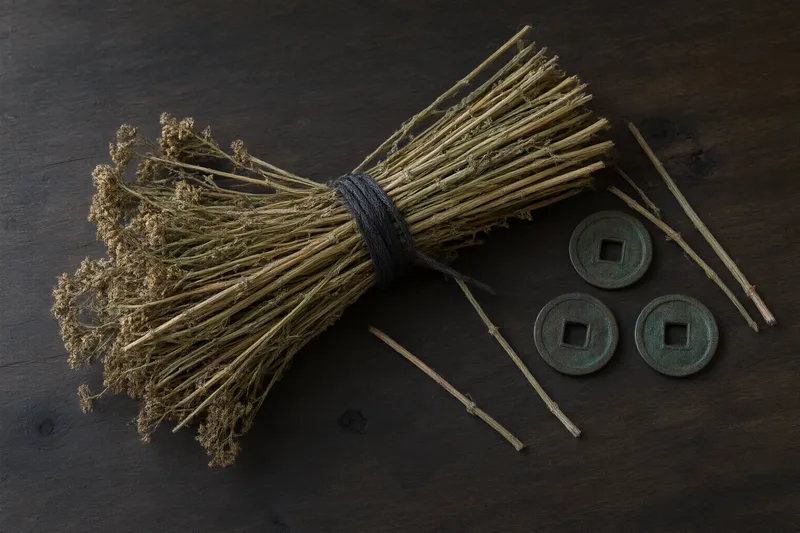
Two methods have survived into the present day. One is slow, uses fifty dried plant stalks, and takes about fifteen minutes per reading. The other uses three coins and takes under a minute. They produce the same six lines on the page, but they do not produce the same odds, and the difference is bigger than most guides admit.
The yarrow stalk method is the older of the two. It is described in the Great Treatise, the commentary attached to the I Ching itself, in a passage that has been read for over two thousand years. The coin method came later and spread widely because it is fast. Both are still in use. Which one you pick changes what kind of answer you tend to get.
What a cast actually produces
Before the methods, the output. A cast produces six lines, built from the bottom up. Each line comes out as one of four numbers, and the number decides the line’s character.
| Number | Line | Meaning |
|---|---|---|
| 6 | Old yin, broken and changing | Flips to a solid line |
| 7 | Young yang, solid and still | Stays as it is |
| 8 | Young yin, broken and still | Stays as it is |
| 9 | Old yang, solid and changing | Flips to a broken line |
The six numbers stacked bottom to top form the primary hexagram. Any 6 or 9 is a moving line, and when you flip each one you get a second hexagram, the transformed one. A reading with no 6 and no 9 has only the primary hexagram. That happens often, and it is information rather than a failure.
If you want the full list of what the sixty-four results mean, the 64 hexagrams reference covers every one in plain English.
The yarrow stalk method
You need fifty stalks. Traditionally these are yarrow, a common herb with stiff dry stems, though bamboo skewers or thin dowels work. One stalk is set aside at the start and never used. It represents the undifferentiated state before the division into yin and yang. Forty-nine stalks do the work.
Each line takes three rounds, called changes. Six lines means eighteen changes.
The first change. Divide the forty-nine stalks into two heaps at random, without counting. Set one stalk from the right heap aside, held between your little finger and ring finger. Now count the left heap down by fours. When fewer than four remain, keep that remainder, somewhere between one and four. Do the same with the right heap. If a heap divides evenly by four, keep four rather than zero.
The remainders plus the single stalk you set aside total either five or nine. Remove them from play. What stays in your hands is forty-four or forty.
The second change. Take the stalks that remain, divide them again into two heaps, and count both by fours as before. This time you do not set a stalk aside first. The remainders total four or eight. Remove them. Thirty-two, thirty-six, or forty stalks remain.
The third change. Repeat the second change exactly. The remainders again total four or eight.
Now count what is left and divide by four. The answer is 9, 8, 7, or 6, and that is your first line, the bottom one. Gather all forty-nine stalks back together and start again for the second line. Eighteen changes gets you six lines.
It sounds mechanical on the page. In the hands it is slow and quiet, and the counting absorbs enough attention that the question sits in the back of your mind the whole time. That is the point of it.
The three-coin method
Take three identical coins. Decide which face counts as 3 and which counts as 2. Traditionally the side with the inscription is yang and counts 3, the blank reverse is yin and counts 2. Toss all three together and add up the faces.
Three heads gives 3+3+3 = 9. Two heads and a tail gives 8. One head and two tails gives 7. Three tails gives 6. Write the number down. That is your bottom line. Toss five more times, moving upward.
One rule matters here. Decide the assignment of faces before the first toss and do not change it midway. People who flip the convention halfway through a reading end up with six numbers that mean nothing consistent.
The odds are not the same
This is the part that usually gets left out. The two methods assign different probabilities to the four possible lines.
| Number | Line | Yarrow | Three coins |
|---|---|---|---|
| 6 | Old yin, changing | 1 in 16 | 2 in 16 |
| 7 | Young yang | 5 in 16 | 6 in 16 |
| 8 | Young yin | 7 in 16 | 6 in 16 |
| 9 | Old yang, changing | 3 in 16 | 2 in 16 |
Both methods produce a changing line a quarter of the time, so the total amount of movement in a reading is identical. The distribution is not.
Look at the two changing lines. With coins, old yin and old yang are equally likely, so a moving line is as likely to be a broken line flipping to solid as the reverse. With yarrow, old yang comes up three times as often as old yin. A yarrow reading that moves at all is far more likely to move in the yang direction.
Traditional readers treat this as meaningful rather than accidental. Yang is the expanding, active principle, and the yarrow odds weight the oracle toward expansion. Whether or not you accept that reasoning, the practical consequence is real: cast the same question with both methods over a long stretch and the yarrow readings will carry more yang movement, while the coin readings will sit closer to an even split.
The yarrow method also produces young yin more often than any other result, seven times in sixteen. Quiet, receptive, unchanging hexagrams come up frequently. If you have ever felt that coin readings turn dramatic too easily, this is why.
Which method should you use
Cast with coins when you need an answer and the moment is now. A decision is in front of you, you have five minutes, and you want the reading rather than a ritual. The coin method is also the better choice for beginners, because the mechanics are simple enough to learn in one sitting and you can give your attention to the question instead of the counting.
Cast with yarrow when the question deserves the time. A career move, an ending, anything you have been circling for weeks. Eighteen rounds of counting is a long time to sit with a question, and people report that the question sharpens on its own somewhere around the second line. The stalks do not do that. The slowness does.
If you want the yarrow odds without the fifteen minutes, a sixteen-sided die labeled in the 1-5-7-3 pattern reproduces them exactly. One face for 6, five faces for 7, seven for 8, three for 9. Roll six times. Some practitioners consider it cheating. It is mathematically identical.
Other methods, briefly
The Plum Blossom method, or Meihua Yishu, skips tools entirely. The practitioner takes a number from the time or the environment, does a short calculation, and derives the hexagram arithmetically. It is a complete system with its own rules, and it belongs to a different school of practice rather than being a shortcut version of the stalk method.
The sixteen-stalk method is a compressed yarrow procedure that produces approximately the traditional odds in one round instead of three. It exists mostly for people who want the feel of the stalks without the full count.
There is also the question of what to do when you have no tools at all. Most teachers say wait. Casting from memory is how people end up with a hexagram they cannot trust.
What does not matter
The coins. Any three identical coins work. The old bronze cash coins with the square hole are traditional and they feel good in the hand, but nothing about the result depends on them.
The surface. A table, a mat, a book. Traditional practice sometimes asks for a clean cloth. Sitting somewhere you can think matters more than what the coins land on.
The direction you face. Some lineages assign directions to the trigrams and care about orientation. Most modern practitioners do not, and there is no textual basis for it in the Great Treatise.
What does matter
Write the question down before the first toss, in your own words. The wording you use shapes what you can hear in the answer.
Cast once per question. If you dislike the hexagram and cast again, you now have two readings and no instruction, and the second one is answering a different question than the first.
Record the raw numbers, not just the hexagram name. Six digits take five seconds to write down and they catch every later mistake. A casting journal turns a pile of readings into something you can actually learn from after the outcomes arrive.
Settle first. A reading taken in a hurry, mid-argument, or right before sleep tends to produce entries you cannot use later. Take three breaths, or take the fifteen minutes with the stalks. Either way, arrive at the question before you ask it.
FAQ
Do I need real Chinese coins to cast the I Ching?
No. Any three identical coins work, as long as you decide in advance which face counts as 3 and which counts as 2. The old bronze coins with a square hole are traditional and pleasant to hold, but the method does not depend on them. Three of the same modern coin give the same results.
How long does the yarrow stalk method take?
Between ten and twenty minutes for a full six-line reading. Each line needs three rounds of dividing and counting, so eighteen rounds in total. The coin method takes about a minute for the same six lines. The time is not wasted, because the slowness is the part most people say changes how they read the answer.
Can I get the yarrow odds without using stalks?
Yes. The yarrow method produces 6, 7, 8, and 9 in a fixed 1-5-7-3 ratio out of sixteen. A sixteen-sided die labeled with one face for 6, five for 7, seven for 8, and three for 9 reproduces those odds exactly. Roll it six times and you have a yarrow reading without the counting.
What if my reading has no changing lines?
A reading with no 6 or 9 has no transformed hexagram, and you read the primary hexagram alone. This is not a broken reading. In the yarrow method it happens about half the time. A still hexagram usually means the situation is stable and the guidance is about the present shape of things rather than a turn ahead.
The two methods disagree about odds and agree about everything else. Six lines, bottom to top, four possible values, changing lines that flip into a second hexagram. Pick the one that fits the question in front of you rather than the one that feels more authentic, because both have been in continuous use for centuries and neither is the wrong answer.
If you want to skip the props entirely, the free I Ching Coin Casting tool handles the tosses and shows you both hexagrams. When a reading has several moving lines and you want each one read in full, the I Ching Deep Reading ($9.99) works through them one at a time.
Read next: the I Ching journal method for how to record a reading so it stays useful, or I Ching for decision making if you are stuck between two choices and want to frame the question properly.