Chinamaxxing and Yang Sheng: The Five Element Logic Behind It
Chinamaxxing turned hot water, moxa, and foot soaks into a TikTok checklist. Yang sheng runs on five element timing, and the habits only work with it.
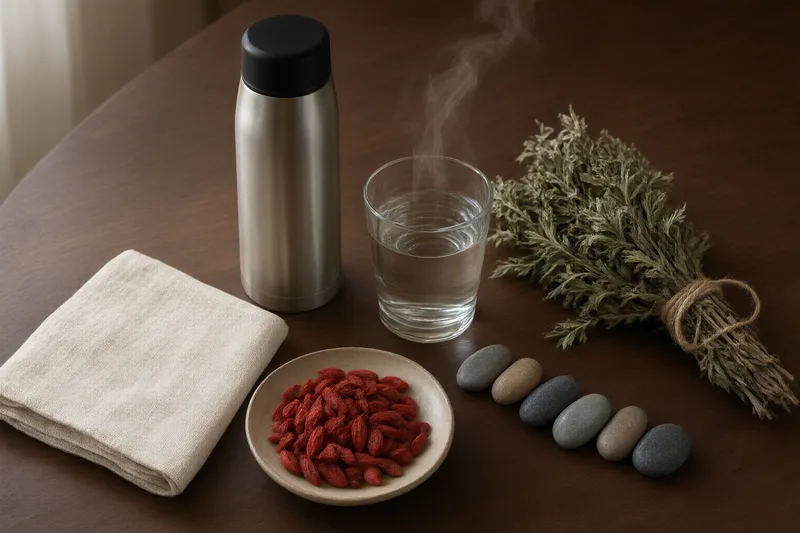
A friend in Ohio sent me a video last month. She fills a steel thermos with hot water, drops in a small handful of goji berries, and tells the camera she has been doing this for sixty days. Her skin, she says, has changed. Her sleep has changed. In the caption she calls it “becoming Chinese,” and the comment section below it runs forty thousand deep with people doing the same thing.
That video is one piece of a trend the internet named Chinamaxxing.
The word follows a pattern you already know. Take a nationality, add the suffix from looksmaxxing and healthmaxxing, and you have a label for a lifestyle people are trying on for size. Chinamaxxing is the Western internet, Gen Z mostly, picking up the ordinary habits of Chinese daily life. Hot water instead of iced. A thermos instead of a cold brew. Moxibustion patches on the belly. A plastic tub of hot water at the feet before bed. Congee for breakfast, slippers indoors, Baduanjin stretches before the laptop opens.
The numbers are not small. The hashtags passed four billion cumulative views by mid 2026. Thermoses exported from China reached five billion yuan in the first quarter of the year alone, with tea close behind at 2.7 billion. In Vietnam, a Shenzhen brand selling a mugwort warming belt through TikTok Shop reported daily revenue peaking above 400,000 yuan. Foreign entries into China hit 22.9 million in the first half of 2026, up more than twenty percent year on year.
So the habits are spreading fast. What travels with them is thinner.
The checklist arrived without the instructions
Watch enough of these videos and a pattern shows up. The creators are precise about what they do and vague about why any of it works.
A woman will tell you that hot water “resets the body,” which is a sentence that sounds like an explanation and contains none. A man will show you his moxibustion patch and say it “clears out the cold,” without saying what cold means, where it came from, or why a sticky patch would move it. The advice arrives as a list of actions with the reasoning stripped off, and a list is the one part of this tradition that cannot survive on its own.
Behind the list sits a system with a name. Yang sheng (养生) translates roughly as health cultivation or life nurturing. It is the half of Chinese medicine that deals with staying well rather than getting treated, and it is old enough that its founding text, the Huangdi Neijing, spends an early chapter on nothing but how the seasons should govern your behavior. Spring is for releasing. Summer is for flourishing. Autumn is for settling. Winter is for storing. The same chapter warns that fighting the season damages a specific organ: the liver in spring, the heart in summer, the lungs in autumn, the kidneys in winter.
Notice what kind of rule that is. It governs timing rather than temperature, and water temperature is only the most visible application.
The five elements are a calendar, not a personality test
In the West, the five elements usually show up as a quiz result. You are Wood, your friend is Fire, and the label gets pinned to a personality and left there.
In yang sheng the same five phases work as a schedule. Each one owns a season, an organ pair, a taste, and a direction of movement, and the whole set turns like a wheel through the year.
| Element | Season | Organ pair | Taste | What the season asks |
|---|---|---|---|---|
| Wood | Spring | Liver and gallbladder | Sour | Move, stretch, start things |
| Fire | Summer | Heart and small intestine | Bitter | Expand, sweat, socialize |
| Earth | Late summer | Spleen and stomach | Sweet | Digest, stabilize, gather |
| Metal | Autumn | Lungs and large intestine | Pungent | Settle, grieve, let go |
| Water | Winter | Kidneys and bladder | Salty | Rest, store, sleep more |
A practitioner reads this table the way a farmer reads a planting calendar. You do not plant in frozen ground, and you do not ask your kidneys to run at summer pace in January. Everyone passes through all five positions, every year, in the same order. Treat them as a place on a calendar rather than a personality label.
That distinction is the whole reason the TikTok version keeps producing strange results. A habit pulled out of its season is a habit running without instructions.
What the viral habits are actually doing
Take the five practices that dominate the trend and put each one back on the calendar.
Hot water in the morning
The spleen and stomach belong to Earth, and the tradition treats them as a stove that prefers to work warm. Cold drinks and raw salads ask that stove to do its job at a lower temperature, and the claim is that the cost shows up later as fatigue, bloating, or a heaviness after meals. Morning is when the body’s yang is rising from its overnight rest, so a cold shock at that hour is the worst-timed version of the habit. Warm water at the start of the day is the low-risk, high-agreement move in the entire system, which is likely why it spread first.
Moxibustion and the mugwort question
Moxibustion burns dried mugwort, ai cao, near a point on the body. Mugwort smolders slowly and holds heat, which is why it gets used instead of some faster-burning herb: the point is steady warmth delivered to a spot, not flame.
In five element terms this is adding Fire to a body that is short on it, or driving out cold that has settled somewhere it should not be. Winter is Water season, when the tradition says to protect and store warmth rather than spend it, so moxibustion has a natural home in the cold months and in people who describe themselves as always cold. The mirror rule matters just as much: someone who already runs hot, wakes sweaty, or gets irritable in summer heat is traditionally steered away from adding more warmth. Same patch. Opposite advice. The season and the person decide which one you get.
Foot soaking at night
The kidney meridian begins on the sole of the foot, at a point called yongquan, and the kidneys belong to Water. A hot soak before bed pulls blood and attention downward at the hour when the body should be winding toward sleep instead of planning tomorrow. Anyone who has done it knows the effect on the feet. The tradition’s explanation is that you are settling qi that had risen into the head, and whether or not that language lands for you, the timing is the active ingredient. The same soak at noon is just wet feet.
Goji berries in the thermos
Goji, gou qi zi, is classified as nourishing the liver and the kidney, which puts it across Wood and Water. It is a mild, food-grade herb rather than a drug, and the traditional use is long and unremarkable: a small handful steeped through the day, not a scoop. The thermos habit and the herb happen to fit each other, since the berries need sustained warmth to give up anything and the thermos supplies it for hours.
Baduanjin before the laptop
Baduanjin, the Eight Brocades, is a set of eight slow movements that takes about twelve minutes. In the tradition it is classified as dao yin, guiding and pulling, a category that includes tai chi and qigong. The eight movements are about flow. They push qi through places it had stalled, mostly the upper back and shoulders, which is where desk work parks it. Twelve minutes of slow movement before sitting down is a different intervention than twelve minutes of the same movements after eight hours of sitting.
Nothing on this list does much by itself, and no single herb is a miracle. That is the point. Yang sheng is a system of small adjustments made at the right time, and the right time is most of what the videos leave out.
The rule that proves the checklist wrong
The cleanest proof that a habit list cannot carry this tradition fits in one Chinese proverb: eat radish in winter, eat ginger in summer.
It sounds backwards. Ginger is warming. Why would you eat a warming food in the hottest season and a cooling one in the coldest?
The answer is where the heat sits. In summer, the tradition says, yang floats to the surface of the body while the interior runs comparatively cool, so a person sweating in July may have a cold center, and ginger warms it. In winter the opposite happens: yang retreats inward and can stagnate as heat, so radish, cooling and dispersing, clears what has built up inside. The food itself is neutral. What changes is whether it arrives early or late in the year, and the season makes that call.
Now run the TikTok list against that rule. “Drink hot water” is right for the person with a cold middle and wrong for the person who runs hot and wakes up with a dry mouth. “Avoid cold food” is good winter advice and a fast way to make a hot, irritable summer worse. Neither the videos nor the comment section can tell you which one you are, because that information was never in the habit. It was in the framework the habit came from.
If you want to know which side of that line you sit on, the Five Elements Quiz takes about two minutes and returns your dominant and secondary elements. From there, eating for your element turns the result into something you can put on a plate.
Appreciation, appropriation, and the honest middle
The trend has a second life as an argument, and it deserves a fair hearing rather than a verdict.
The reception inside China has been warmer than you might expect, with one recurring caveat: what reaches the West is the habit, and the reasoning stays home. A medical system with two thousand years of internal logic arrives as a shopping list, and the parts that require study, the diagnosis, the pulse reading, the reasoning about your particular body, do not fit in a fifteen-second clip. There is a real difference between borrowing a thermos and borrowing a framework, and the trend so far has mostly borrowed the thermos.
Both halves of that are true at once. Nobody needs a license to drink warm water, and a Gen Z creator in Ohio experimenting with congee is not committing an act of theft. But a checklist without the reasoning behind it is a costume, and costumes come off. The people who stick with these habits past the trend are usually the ones who went and read why.
That reading is available, which is the part the argument tends to skip. The tradition is not hidden. The complete guide to the five elements covers the cycles in plain language, and the Chinese body clock shows the same logic applied to the hours of the day rather than the months of the year. If the trend brought you here, the next step is smaller and slower than a new habit. It is finding out which season you are in.
FAQ
What is Chinamaxxing?
Chinamaxxing is the Western internet’s name for adopting ordinary Chinese daily habits, mostly wellness ones: hot water instead of iced drinks, a thermos, moxibustion patches, foot soaks, congee, indoor slippers, and Baduanjin stretches. The suffix comes from looksmaxxing and healthmaxxing. The trend formed in late 2025 and surged around Chinese New Year 2026, and its hashtags passed four billion views.
Is drinking hot water actually good for you?
The tradition says warmth supports the spleen and stomach, which belong to the Earth element, and that cold drinks ask the digestive system to work at a lower temperature. That is a framework claim, not a clinical finding, and the evidence for it is traditional rather than experimental. What is uncontroversial is that replacing sugary cold drinks with plain warm water changes what you consume in a day.
What does yang sheng mean?
Yang sheng (养生) translates roughly as health cultivation or life nurturing. It is the branch of Chinese medicine concerned with staying well rather than treating illness, and its central rule is timing: sleep, food, exercise, and emotion are adjusted to the season and to the person. The Huangdi Neijing devotes an early chapter to setting one season against each phase: release in spring, flourish in summer, settle in autumn, store in winter.
Why does moxibustion use mugwort?
Mugwort (ai cao) burns slowly and holds heat, which makes it useful for warming a point on the body without burning the skin. In five element terms moxibustion adds warmth, so it suits cold conditions and cold seasons, and it is traditionally avoided for people who already run hot. The warmth is the mechanism in the tradition’s terms, and mugwort is the fuel that delivers it steadily.
Can I practice yang sheng without knowing my element?
You can start, and your element sharpens the details later. Two habits work for almost everyone: warm drinks over iced, and going to bed before midnight with the phone out of reach. The finer adjustments, which taste to favor and which season to push in, depend on whether you run hot or cold, and a short five element quiz is the quickest way to find that out.
What to take from all this
None of this is medical advice, and none of it replaces a doctor. If you have a diagnosed condition, an allergy, or a medication interaction to worry about, that comes first, and no element logic overrides it. Moxibustion in particular burns skin when it is done carelessly, so it belongs in trained hands or not at all.
Set that aside and there is still something worth keeping from the trend. The habits going viral are mostly gentle, mostly cheap, and mostly harmless, which is more than can be said for most things that spread this fast. The mistake is treating them as a finished product. They are fragments of a schedule.
My friend in Ohio is still drinking from the thermos. She told me last week that she has started noticing when she wants cold water and when she wants warm, and that the wanting changes with the weather. That is the framework arriving on its own, one season at a time. Nobody sent her the table. She found the edge of it by paying attention to a habit she had already picked up. It is a slow way to learn a two-thousand-year-old system, and it is not a bad one.