I Ching Deep Dive: The Creative (Qian 乾)
Qian is the first hexagram of the I Ching. Six yang lines form heaven above heaven. Read the judgment, the image, and lines to understand the Creative.
Six solid lines, stacked from bottom to top, with nothing else on the page. That is Qian, hexagram 1, the first entry in the I Ching. The book does not ease you in with a gentle symbol. It starts with the purest form of creative power in the entire system, doubled heaven, six yang lines with no yin to soften them.
Most people meet Qian in a one-line summary: it means success, it means action, cast it and go. That reading is not wrong, but it is thin. The hexagram carries a full philosophy of how things begin, how they rise, and where they fall. The six lines alone describe an entire career in six positions.
This article walks through the whole hexagram, from the name to the judgment to each of the six lines, and ends with how to read it when it shows up in your own cast.
The name: Qian, heaven, the creative
The character 乾 (qián) carries meanings of dry, of heaven, of the male principle, of the energetic and initiating. In the I Ching it names the first of the eight trigrams, three solid lines, and also the hexagram built from doubling that trigram.
Heaven above heaven. The image is not one god in one sky. It is the sky repeating itself, the same power above and below, which gives Qian its distinct quality. Whatever this energy is, it is not a one-time event. It is a condition that keeps generating itself.
In the family structure of the hexagrams, Qian is the father. Kun, hexagram 2, is the mother. Every other hexagram is their offspring. When the book opens with the father, it is making a statement: before anything can be received, before anything can be nourished, something has to initiate. Qian is that something.
The judgment: yuan heng li zhen
The judgment of Qian is four characters, and they are the most important four characters in the whole book. 元亨利贞.
元 (yuán) means origin, the sublime beginning. 亨 (hēng) means success, something that flows and opens. 利 (lì) means furthering, advantageous, serving a purpose. 贞 (zhēn) means perseverance, correctness, holding a course.
The classic translation reads: The Creative works sublime success, furthering through perseverance. Four words that describe how real creation happens. The origin is present, the flow is unobstructed, the action is useful, and the whole thing holds because someone persists.
Here is the part people miss. Success in Qian is not a result you receive. It is a condition you maintain. The judgment does not say the Creative is successful. It says the Creative works, and the success furthers through perseverance. The energy has to keep moving, and the person has to keep going, or the hexagram collapses into its opposite.
These four characters appear again and again across the 64 hexagrams, in various forms. Qian is where they are stated in full, because Qian is where they belong to the nature of things.
The image: heaven moves with vigor
Every hexagram carries an image, the natural scene that explains how to behave. For Qian it is one of the most quoted lines in Chinese thought.
天行健,君子以自强不息. Heaven moves with vigor. The noble one strengthens himself without ceasing.
Look at the first half. Heaven does not rest. The sun rises, crosses, sets, rises again. The seasons turn without asking permission. The image is not a burst of energy that lights up and dies. It is an unbroken rhythm.
That is the real lesson of Qian, and it is the opposite of what most people expect from a hexagram about the creative. The creative is not a flash of inspiration. It is a steady strengthening, a person who works on the self the way heaven works on the sky, without stopping.
The second half matters just as much. The strengthening is not directed at the world. It is directed at the self. The noble one works on himself before he works on the situation. Qian energy misused is a force that tries to move everything outward. Qian energy understood is a force that first builds the mover.
The six lines: the rise of the dragon
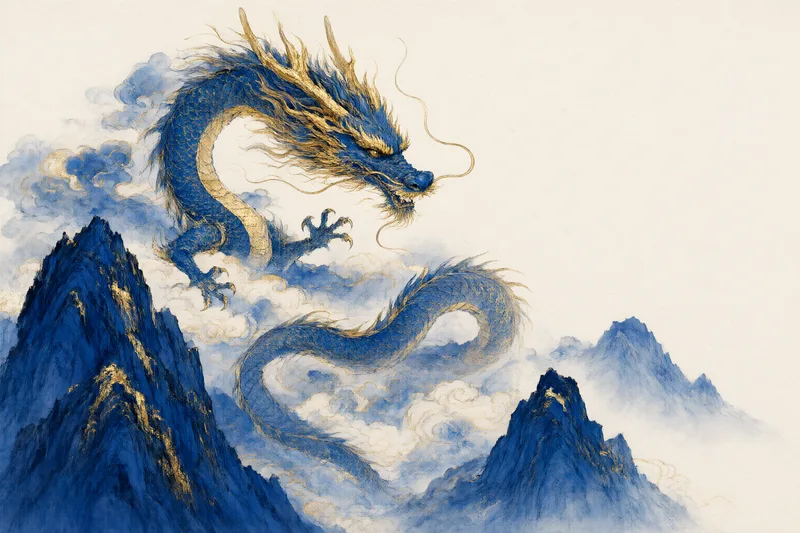
Qian is famous for its six line texts, which use the dragon as their symbol. Read them in sequence and they tell one continuous story, the arc of a leader from hidden to flying to overreaching.
The first line: hidden dragon, do not act. The lowest position, the youngest energy, the talent not yet recognized. The advice is not to hide forever and it is not to rush out. It is to develop in silence. A dragon at this stage has no public role. The mistake people make is forcing visibility before the foundation exists. The right move is preparation without display.
The second line: dragon appearing in the field. It furthers to see the great man. The first public appearance. The dragon is now visible in the world, and seeing a great person furthers one. This is the moment when talent starts to be recognized. The field is a middle space, not the throne and not the swamp. Visibility has begun, and the response to it should be openness, letting the right people see you work.
The third line: the noble one works all day, and in the evening is still alert. Danger, but no blame. This is the working line, the long middle of the climb. The third position sits between the low and the high, which makes it unstable. The person in this line works through the day and keeps watch at night, because the position is genuinely dangerous. The reward is that there is no blame. The danger is real, and the diligence cancels it.
The fourth line: hesitant leap, over the abyss. No blame. The fourth position is the boundary between the subordinate and the ruler. The dragon is not yet at the top, but it is no longer at the bottom. The text does not say jump. It says hesitate, test, leap when the conditions are right. The abyss below is the consequence of a leap made too early. The wise reading is a cautious commitment, trying the water before crossing.
The fifth line: flying dragon in the heavens. It furthers to see the great man. This is the peak of the whole hexagram, the ideal position. The dragon has risen to the sky, and everything is aligned. The fifth line is the ruler’s seat in every hexagram, and in Qian it is reached at full strength. This is the moment of complete expression, when the creative power is fully realized and the work speaks for itself.
The sixth line: the dragon overreaches. There is cause for regret. The top line, the position past the peak. The dragon has flown too high and can only descend. This is the warning built into Qian: strength without restraint turns into its own undoing. Every leader who has ever fallen did so from this line, having mistaken the fifth for a resting place instead of a summit.
Then, beyond the six lines, comes a special text unique to Qian and Kun, the 用九 (yong jiu) for Qian: the dragons appear without a head. Success. The image of many dragons, none of them insisting on being the leader. It is the answer to the top line’s warning. Creative power at its best is not one dragon claiming the sky. It is many dragons moving together, no single head, and that is where fortune lies.
What the six lines mean for a project
Read Qian not as a fortune but as a map, and it becomes remarkably practical.
Every project you start passes through these six positions. In the beginning you are the hidden dragon, and the work is to build skills no one sees yet. Then you appear in the field, and the task is to let the right people notice. Then comes the long working middle, where the danger is real and the only protection is diligence. At the fourth line you face the leap, the decision to commit fully, and the text tells you to hesitate deliberately before you take it. At the fifth line you are flying, and the work is to enjoy it while it lasts. At the sixth, if you stay too long, the overreach takes over.
The discipline of Qian is knowing which line you occupy. Most failures in ambitious projects are a mismatch between position and action. A first-line person trying to act like a fifth-line person, forcing the leap before the foundation. Or a fifth-line person refusing to see that the position is a summit, not a plateau. Qian rewards the actor who knows his place in the sequence.
Reading Qian in your own cast
When Qian shows up in a reading, ask what is being born. Qian appears at the start of things and at the peak of their energy, so its meaning depends on context.
If the question is about a new venture, Qian is a strong endorsement of the initiating energy. The forces are with you, and the judgment invites you to act. But remember the condition: act with perseverance, not with a burst.
If the question is about a situation already at its height, Qian becomes a warning. Check the top of the arc. Is this a fifth line, where the flight is legitimate? Or a sixth line, where overreach is starting? The same hexagram that blesses a beginning cautions a climax.
The moving lines sharpen the reading. Each one places you in a position on the dragon’s path. A first-line moving line says you are still in the hidden stage and should stay there. A fifth-line moving line says the peak is genuinely yours. Read the line text as a position report, and the hexagram stops being abstract.
Where Qian leads when lines change
When a line changes, Qian transforms into another hexagram, and that transformation shows the direction of the situation. The six directions of the Creative:
- First line changes, Qian becomes hexagram 44, Coming to Meet. A hidden encounter, something new appearing quietly. Watch what arrives unannounced.
- Second line changes, Qian becomes hexagram 13, Fellowship with Others. The public dragon attracts allies. The work moves forward with companions.
- Third line changes, Qian becomes hexagram 10, Treading. The daylong worker must walk carefully, like treading on a tiger’s tail. Caution becomes the discipline.
- Fourth line changes, Qian becomes hexagram 9, Small Taming. The cautious leap needs small, steady restraints before the big commitment.
- Fifth line changes, Qian becomes hexagram 43, Breakthrough. The flying dragon reaches a decision point, and the breakthrough must be made resolutely.
- Sixth line changes, Qian becomes hexagram 6, Conflict. The overreaching dragon steps into a dispute. The regret the line warned about takes shape.
For a full list of the 64 hexagrams and their core meanings, the 64 hexagrams reference gives you the quick picture of any destination. For the foundations of reading, the guide to the Book of Changes explains how the whole system fits together.
FAQ
What does the Qian hexagram mean in the I Ching?
Qian is hexagram 1, The Creative. Six solid yang lines form heaven above heaven, pure creative power. It stands for the initiating force behind every new beginning, and its judgment, yuan heng li zhen, describes a success that only holds when paired with perseverance.
What does each line of Qian tell you?
The six lines tell the rise of a dragon: the hidden line that must not act, the public appearance, the daylong working line, the cautious leap, the flying dragon at the peak, and the overreaching line that brings regret. Wherever you are in a project, one of those six positions fits.
Is Qian always a positive hexagram?
No. The energy is strong, but the top line is a warning: a dragon that flies too high regrets it. Qian rewards action that matches the position you hold. Acting like the fifth line while you still occupy the first brings failure, not success.
What happens when a line changes in a Qian reading?
Each moving line transforms Qian into another hexagram. Line one becomes Coming to Meet, line two becomes Fellowship, line five becomes Breakthrough, and so on. The changed hexagram shows where the creative momentum is heading, so you can read the direction of your situation.
Qian is the first hexagram for a reason. Before anything can be received, something must begin, and the whole art of beginning is in these six lines. Know which position you hold, work with the persistence of heaven, and the creative energy does what it was always going to do.
Cast your own reading with the free I Ching Coin Casting tool. If you want your hexagram read line by line, the I Ching Deep Reading ($9.99) walks through every moving line and shows the transformed hexagram with classical commentary.
Read next: I Ching in Daily Life for how Qian works alongside the other everyday hexagrams, or I Ching for Decision Making when you are stuck between two paths.