I Ching in Daily Life: 5 Hexagrams to Know
The I Ching is not only for big decisions. Five hexagrams appear in daily life. Learn to read Qian, Kun, Kan, Yi, and Gen, and what to do when they appear.
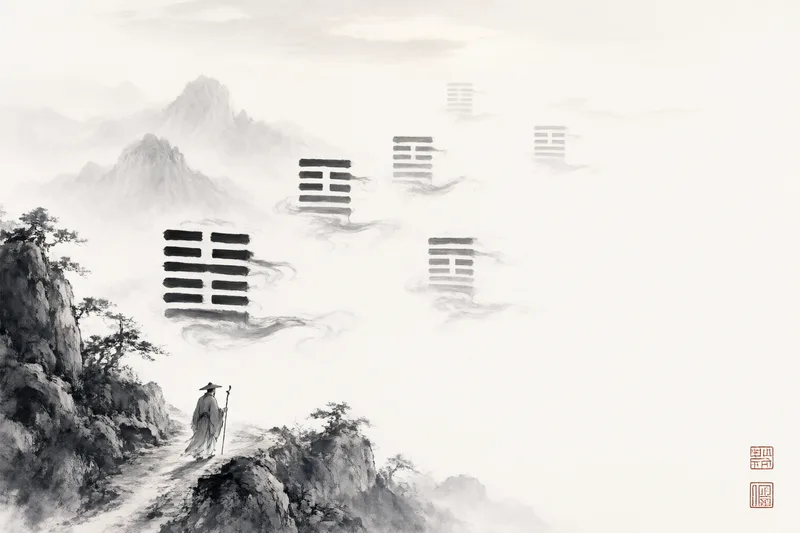
Most people open the I Ching only for the big moments. A job offer. A move. A relationship hanging by a thread. The rest of the time the book sits on a shelf, and that is a waste, because the hexagrams were written for ordinary days.
The same five hexagrams keep appearing in everyday readings. They cover the states we cycle through all the time: starting, cooperating, struggling, gaining, and resting. Once you know them by heart, a daily consultation stops feeling like deciphering a foreign language.
This guide gives you the core reading of each one and what to do when it shows up. No memorizing all 64. Five is enough to start.
Hexagram 1, Qian (乾), The Creative
Six solid lines, nothing else. Qian is pure forward motion, the most active energy in the whole book.
It appears when a door opens. A new job. A proposal. A project you have been circling for months. The judgment for Qian is short and severe: this is the time to act, because the energy is with you.
People misread this hexagram in two directions. The first is hesitation. You get the sign to move and you keep asking for more signs. The second is the opposite. Qian is also the symbol of the overconfident leader, the dragon that flies too high and regrets it. The line texts warn against the arrogant ruler more than the timid one.
If Qian shows up in your reading, ask yourself one question: have I been waiting for permission that only I can give? When the direction is already clear, the answer is usually yes, and that is your answer.
Hexagram 2, Kun (坤), The Receptive
Six broken lines. Kun is the earth, the field, the vessel. Where Qian is the lightning, Kun is the ground that receives it.
Kun appears when you are being asked to follow, support, or wait. A team project where you are not the lead. A season of study. A relationship that needs patience instead of grand gestures.
Here is the part people stumble on: Kun is not weakness. The earth holds up every tree and every building, and it breaks nothing by being still. The judgment praises the mare who follows her own course, who serves without losing direction. Following, in this hexagram, is not the same as surrendering.
When Kun appears, put the ambition on pause and take up the supporting role fully. Listen before you speak. Watch before you act. The payoff is not dramatic, but it is real. The ground always outlasts the storm that passes over it.
Hexagram 29, Kan (坎), Water, The Abyss
Two waters stacked, the abyss. This is the hexagram of the hard stretch, the period when things keep slipping.
Kan appears in the moments people consult the I Ching about most: a stalled project, a health setback, a string of small failures. The judgment does not pretend the danger is imaginary. It says the danger is real, and it says something more useful, that the danger repeats, and that you can be trained by it.
Water does not panic when it hits a rock. It deepens, finds the lower path, and keeps moving. That is the reading for a Kan period. Lower your expectations about speed, keep your conduct honest, and treat each repetition as practice. The danger is not a wall. It is a training ground.
The one thing Kan punishes is the rush to escape. People who jump out of a difficult period too fast usually jump back in. Stay in the water, learn what it is teaching, and let the exit come from the lesson, not from impatience.
Hexagram 42, Yi (益), Increase
Yi is thunder over wind. Something is being added. This is the hexagram of the open window.
Yi appears when an opportunity lands in your lap. A referral. A proposal you did not solicit. Resources arriving at exactly the right moment. The judgment is among the most favorable in the book: it furthers one to undertake something, it furthers one to cross the great water.
But Yi has a condition hidden inside the good news. The increase is never free. The character itself carries both gain and benefit given to others, and the image reads as removing from the top to add to the bottom. The question that matters when Yi appears is not what you can take, but what the increase makes possible for the people around you.
So when this hexagram shows up, move. The window is real. But ask what the gain is for. If the answer is only yourself, the increase will not last.
Hexagram 52, Gen (艮), Keeping Still
Two mountains. Gen is the image of stopping, and it is the most underrated hexagram in daily life.
Gen appears when you are exhausted, when someone is pushing past a boundary, when the noise is louder than the signal. Everything in you says keep going, and the hexagram says the opposite. Stop.
The judgment is strange until you sit with it. Keeping still at the back, no feeling in the body, one walks into the courtyard and does not see the people. It describes a person who can stop thinking about what others think. That is a skill, not a defeat.
Most people burn out because they treat Gen as a failure. It is not. It is a reset. The mountain does not disappear because you rest on it. When Gen appears, do not decide anything. Do not send the email. Do not resign. Let the situation cool until the noise separates from the signal. The answer you stop chasing will come to you.
How the five fit together
Read the five as a cycle and they stop being random symbols.
You start something, and that is Qian. You move into a phase of cooperation and patience, and that is Kun. Somewhere a difficulty repeats, and that is Kan. Then an opening arrives, and that is Yi. Then you need to stop and consolidate, and that is Gen. Start again.
Real life is not a straight line through all five. But most stretches of ordinary days will map onto one of them. When you cast, you are not getting a random fortune. You are getting a location on a map you already know. That is what daily I Ching use feels like. Not magic, just navigation.
What to do about changing lines
A hexagram is rarely still. When you cast with the I Ching Coin Casting tool, changing lines turn one hexagram into another, and the line texts carry the detail.
For the five here, the rule is simple. Read the main hexagram for the situation, read the changing lines for the specific warning or nudge, and read the transformed hexagram for where the momentum is heading. The 64 hexagrams reference gives you the full picture, and the guide to the Book of Changes covers the background if you want the history.
FAQ
Can I use the I Ching for small everyday questions?
Yes, but only for the ones that matter. A daily consultation is not for what to eat for lunch. It is for the small decisions that carry weight: whether to speak up in a meeting, whether to accept a favor, whether to push a project forward or wait a week. The I Ching earns its keep on questions where your own reasoning has gone quiet.
Do these five hexagrams appear more often than others?
They appear more often in practice, and there is a reason. Everyday life is mostly made of starting, cooperating, struggling, gaining, and resting. Those states map naturally to Qian, Kun, Kan, Yi, and Gen. The other 59 hexagrams describe specific situations. These five are the weather.
What if I keep getting the same hexagram?
Repetition is a signal. If Kun keeps showing up, there is a pattern around following and waiting that you have not fully understood. The I Ching is not malfunctioning. It is pointing at the lesson you keep circling. Sit with the hexagram that repeats, and ask what part of it you have refused to accept.
Do I need to memorize all 64 hexagrams?
No. Most people never do, and daily use does not require it. Start with these five, then add the ones that keep showing up in your own readings. The book rewards familiarity over completeness.
Daily I Ching use is not about getting answers from the sky. It is about having a language for the states you move through anyway. Five hexagrams give you the vocabulary.
Cast your first reading with the free I Ching Coin Casting tool. When a hexagram arrives and you want the full interpretation, the I Ching Deep Reading ($9.99) walks through your lines one by one.
Read next: the I Ching guide for the foundations, or the 64 hexagrams reference to look up any hexagram you encounter.