Feng Shui for Skeptics: 3 Rules to Try Before You Decide It's Nonsense
I thought feng shui was superstition too. Then I tried 3 things that cost $0 and took 30 minutes. My sleep improved in 3 days. Here's what happened.
I didn’t believe in feng shui. I’m the kind of person who hears “energy flow” and reaches for a research paper. If you’d told me a year ago that I’d be writing about ancient Chinese home arrangement, I’d have laughed.
Then I tried three things that cost me nothing.
Three days later I was sleeping better. Not “I think I’m sleeping better.” My sleep tracker showed 23 more minutes of deep sleep per night. I was waking up once instead of three times. My partner, who had no idea I’d changed anything, said “you seem less tired this week.”
I still don’t think invisible energy dragons live in my ceiling. But something real was happening, and I wanted to understand what.
Here is what I learned . And the three rules anyone can test in an afternoon.
The Problem with How We Talk About Feng Shui
Feng shui has a marketing problem.
One side talks about it like magic: move your bed 15 degrees northeast and money floods through your front door. The other side dismisses it entirely. It’s just Chinese superstition dressed up as interior design.
Both sides are annoying, and both miss the point.
What the early Chinese practitioners observed, over centuries without EEG machines or sleep labs, is that your physical environment changes how your brain functions. They described it through the language of their time: qi (energy), yin and yang (balance), the five elements. But you don’t need to believe in any of that to experience what happens when you rearrange your room.
Modern research backs up a surprising number of feng shui principles. Environmental psychology has spent decades proving that sightlines affect stress, clutter increases cortisol, and the position of your bed relative to the door shapes how deeply you sleep.
Feng shui isn’t magic. It’s a 3,000-year-old observation system that noticed things science is only now measuring. The ancient Chinese didn’t know about the sympathetic nervous system. They just noticed that people with their backs to the door were more anxious, and called it bad qi.
Different language. Same phenomenon.
Here are the three rules I tested. None of them require belief, money, or a compass. Just an afternoon and a willingness to be wrong.
Rule 1: The Command Position for Your Bed
This is the one that changed my sleep.
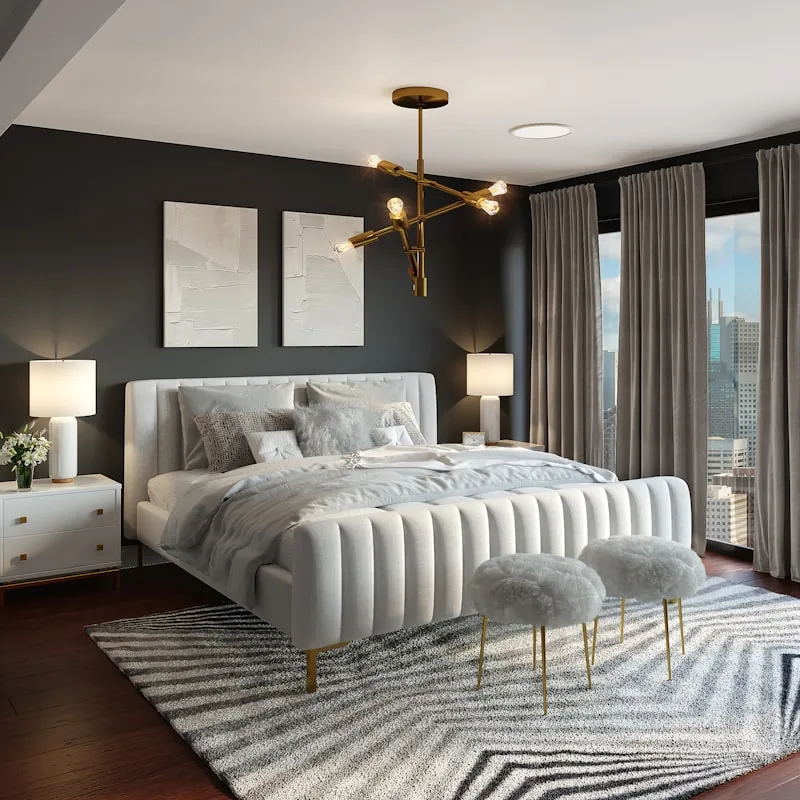
The rule: your bed should be positioned so you can see the door from where you lie, without being directly in line with it. Ideally, the bed has a solid wall behind the headboard and space on both sides.
When I looked at my own bedroom, I failed on every count. My bed was directly in line with the door. One side was pushed against the wall. And the head of the bed sat under a window.
The feng shui explanation: Your bed in line with the door means energy rushes straight at you while you sleep. A window behind your head means your energy has no support while you’re unconscious and vulnerable. Both lead to restless sleep and waking up drained.
The science: Your brain doesn’t fully turn off when you sleep. Part of it, the reticular activating system, stays online, scanning for threats. If you can’t see the door from your bed, your subconscious never fully relaxes. It’s the same reason you sleep worse in hotel rooms for the first few nights: unfamiliar environment, no visual control over the entry point.
A 2016 study in Current Biology found that people in unfamiliar environments sleep with one hemisphere of the brain more awake than the other, a phenomenon called the first-night effect. The researchers speculated this was an evolutionary holdover: your brain keeps watch because it doesn’t know if the environment is safe.
Feng shui practitioners noticed this 3,000 years ago and gave it a name. They didn’t have the vocabulary of hemispheric sleep asymmetry. They just observed the pattern: people whose beds faced the door slept worse than people whose beds commanded the room.
When I moved my bed so I could see the door, but wasn’t directly in front of it, the effect was almost immediate. I felt safer. But more importantly, I was safer: being able to see the door eliminated the low-level vigilance my brain had been running every night without my conscious awareness.
How to try it: Lie on your bed. Can you see the door without lifting your head? If yes, good. If not, can you move the bed so you can? Don’t put it directly in line with the door (which feng shui calls the “coffin position,” and while the name is dramatic, the principle, not sleeping in the direct path of whatever enters, is sound). If you absolutely cannot move the bed, add a mirror that lets you see the door from where you lie. Not ideal according to traditional feng shui, but better than being blind to the entrance.
This is one piece of a larger system. See our bedroom feng shui guide for the full set of rules.
Rule 2: Clear the Space Under Your Bed
I expected this one to be nothing. A waste of time. Storage under the bed is practical. You’re using dead space. What could possibly be wrong with that?
I had a lot of things under my bed. Old suitcases. Boxes of cables. A guitar case I hadn’t opened in two years. Books I meant to read. An exercise roller I used twice. The usual graveyard of good intentions.
The feng shui explanation: Energy needs to circulate around you while you sleep. Things under the bed block that circulation and create stagnant, heavy energy, the opposite of the light, moving energy you want in a bedroom. Over time, sleeping above clutter drags your own energy down.
The science: Here the mechanism isn’t neurological. It’s psychological. Every object you own imposes a tiny cognitive load. You might not be consciously thinking about the guitar case under your bed, but your brain knows it’s there. It knows the cables need sorting. It knows the books remain unread. This is what psychologists call attentional residue: unfinished business, literal and metaphorical, that your mind can’t fully release.
Clutter in the bedroom is especially potent because your bedroom should signal one thing to your brain: rest. When your sleeping space doubles as a storage unit, the mixed signal undermines the association. You’re trying to relax in a room that is telling you, simultaneously, about unfinished projects, abandoned hobbies, and things you should get around to.
A 2009 study in the Personality and Social Psychology Bulletin found that women who described their homes as cluttered had higher cortisol levels and more depressed mood across the day than women who described their homes as restful. The bedroom, where you spend a third of your life unconscious, is the worst place to stack cognitive debt.
Clearing under my bed took forty minutes. I threw away half of it, moved the rest to a closet. The change wasn’t dramatic. But the bedroom felt lighter. That’s a subjective word, but it was the right one: the room felt less heavy to enter. My mind quieted faster at night. Nothing magical. I’d just removed a layer of subconscious noise I hadn’t known was there.
How to try it: Take everything out from under your bed. All of it. If you genuinely need the storage, keep only things that are actually used, and store them in breathable containers (not plastic). But honestly, if it’s been under there more than six months, you probably don’t need it. Give yourself one empty week under a clear bed and see if anything shifts.
Rule 3: Fix What’s Broken
This one sounds obvious, but the feng shui reasoning behind it is interesting enough to include.
The rule: Don’t keep broken things in your living space. A clock that stopped. A chair with a loose leg. A lamp with a burned-out bulb. A phone screen that’s been cracked for three months. Fix it or get rid of it.
The feng shui explanation: Broken objects represent blocked, stagnant energy. Every broken thing in your home is energy that has stopped moving. Surrounding yourself with broken objects teaches your subconscious that brokenness is normal, and over time, you stop noticing when things in your life aren’t working.
The science: This is the broken windows theory, but applied to your home instead of a neighborhood. The original criminology study found that visible signs of disorder (broken windows, graffiti) signal that no one is paying attention, which invites more disorder. Applied to your living space: a broken lamp tells your brain that this environment isn’t maintained. One unfixed thing makes it easier to leave the next thing unfixed. The tolerance for disorder creeps up.
There’s also a decision-fatigue angle. Every broken thing in your home is an open loop: an incomplete task that your brain tracks in the background. The cracked phone screen. The door handle that sticks. Each one is a tiny “you should fix this” notification that fires every time you encounter it. Individually they’re minor. Collectively they’re a low-grade stress drip that never turns off.
This connects to something traditional Chinese medicine observed independently: your environment and your body aren’t separate systems. The same pattern of “blocked flow” that shows up as broken objects in your home often shows up as disrupted sleep. That’s why people who wake up at the same time every night often find the answer isn’t in their body but in their surroundings.
I walked through my apartment with this lens and found seven broken things I’d stopped seeing. The blinds that didn’t close all the way. A drawer handle that came off six months ago. A light bulb in the hallway I’d been walking past in the dark because I was too lazy to find the stepladder.
Fixing them took a Saturday morning and cost about thirty dollars. The effect wasn’t dramatic, but it was real. A quiet sense that my space was actually working. That someone was paying attention. That things in this environment get taken care of.
How to try it: Walk through every room. Touch everything. Open every drawer, flip every switch. Make a list of anything that doesn’t work the way it should. Fix five things on the list this weekend. Notice whether the remaining broken things become harder to ignore. That’s the awareness coming back.
What These Three Rules Have in Common
None of them required buying anything. None of them required believing anything. They were all about removing rather than adding: removing the bed from the door’s path, removing the clutter from under the bed, removing the broken things from your environment.
This is what feng shui actually is, at its core: not adding lucky objects to a room, but arranging a space so it doesn’t work against you. The best feng shui adjustments are often subtractions, not additions.
I’m still not the person who talks about “energy flow” at parties. But I’ve stopped rolling my eyes when someone brings up feng shui. The system is old, sometimes weird, and easy to mock. But buried under the mysticism there’s a practical observation that I now believe is true: your space shapes your mind more than your mind shapes your space.
Try the three rules. They cost nothing but an afternoon. If nothing changes, you’ve lost nothing. If something does, well. Maybe the ancient Chinese were onto something after all.
Your Element Affects Your Space
Feng shui adjustments work better when they match your elemental type. Wood types need different bedroom arrangements than Metal types. Take our free Five Elements quiz to find your dominant element. It takes two minutes and changes how you think about every room in your home.
Next: Your WFH Desk Is Killing Your Career: 5 Feng Shui Fixes Anyone Can Do. The command position for the room where you earn your living.