Your WFH Desk Is Killing Your Career: 5 Feng Shui Fixes
Back to the door, facing a wall, cluttered desk, your home office might be quietly working against you. Five fixes that take 20 minutes and cost nothing.
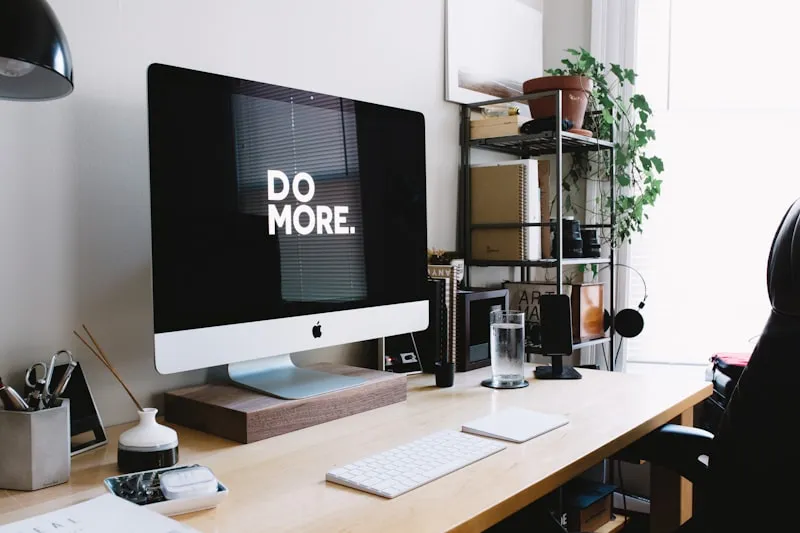
I’ve worked from home for years. For most of that time, my desk was in the worst possible position and I had no idea.
I sat with my back to the door, facing a blank wall. The window was behind me, so anyone on a video call saw a glowing silhouette. My desk was cluttered with cables, coffee cups, and things I told myself I’d deal with tomorrow. And every day around 2 PM, I’d hit a wall of fatigue that made deep work impossible.
I thought that was normal. It wasn’t. It was my setup working against me.
I didn’t start believing in energy flow. I just moved my desk. And the difference was physical, not metaphysical. The principles of feng shui map almost perfectly to what we now know about focus, stress, and cognitive performance. The ancient Chinese noticed patterns. Modern psychology confirms them. The fixes cost nothing.
Here are the five rules, ranked by how badly I was breaking them.
Fix 1: See the Door Without Being in Line With It
This is the command position, the same rule that governs bed placement, applied to your desk. You should be able to see the door from where you sit, but your desk should not be directly in the path between the door and the rest of the room.
Why it matters: Your brain has a threat-detection system that never fully powers down. When your back is to the entrance of a room, your subconscious stays in low-grade vigilance mode, you can’t see what’s approaching, so a part of you stays braced. Over an eight-hour workday, this translates to a background hum of stress you stop noticing but never stop feeling.
A 2018 study on open-plan offices found that employees who sat with their backs to walkways reported 37% higher stress levels than those who faced the room, even when they couldn’t articulate why. The researchers called it “visual control over the environment.” Feng shui calls it the command position. Same thing.
The fix: If possible, rotate your desk so you face into the room, with a solid wall behind you. You don’t need to be directly facing the door, diagonal is fine. The goal is to see who enters without turning around. If you absolutely cannot reposition, add a small mirror to your monitor setup that shows you the door behind you. It’s not as good, but it gives your brain the visual information it’s looking for.
Fix 2: Solid Wall Behind You, Not a Window
My desk had a window behind it. I thought this was a good thing, natural light, a view, what’s not to like?
Why it matters: In feng shui, a window behind your desk means your ideas have no support. The energy you generate at your desk flows straight out the window instead of being held and reflected back.
The modern translation is simpler: a window behind you means your video calls look terrible (backlight = silhouette), your monitor catches glare, and, most importantly, you never see who or what is approaching. It’s the visual-control problem from Fix 1, amplified. A window at your back is the opposite of the command position: you are maximally exposed and minimally aware of it.
There’s also a thermal-comfort angle. Windows are colder in winter and hotter in summer. If your back is against one, your body is spending energy regulating temperature instead of focusing. It’s subtle, but it adds up over hours.
The fix: Solid wall behind your back. If that means your desk faces the window instead, good. Natural light on your face improves mood, reduces eye strain, and makes you look human on Zoom. If the only wall is the one with the door, prioritize seeing the door over the wall. A room divider or tall bookshelf can create the feeling of a wall behind you if you’re stuck.
Fix 3: Your Desk Is Not a Storage Unit
I used to think a messy desk meant I was busy and important. Turns out it meant I was distracted and inefficient.
Why it matters: Every object in your visual field competes for your brain’s attention. A 2011 study from the Princeton Neuroscience Institute found that physical clutter in your visual field restricts your ability to focus and process information. The mechanism is straightforward: your visual cortex has to work harder to parse a cluttered scene, which leaves less processing power for whatever you’re actually trying to do.
Feng shui practitioners would say the clutter blocks the flow of qi. The neuroscientist would say it increases extraneous cognitive load. The practical result is the same: a messy desk makes you worse at your job.
The drawer principle applies here: if you have a drawer, put things in it. If something doesn’t have a home, it becomes visual noise. The goal is a desk that, when you sit down, presents you with only the thing you are working on right now.
The fix: Clear everything off your desk that you aren’t actively using today. Everything. Put the cables in a drawer. Stack the notebooks on a shelf. The coffee cups go to the kitchen. At the end of each workday, reset the desk to blank. Tomorrow’s you will sit down to a clean surface and a clear mind, and that sounds like a platitude until you experience the difference.
Fix 4: The Left Side of Your Desk Is for Wealth
In feng shui, the left side of your desk, as you sit facing out, is the wealth and prosperity zone. The right side is the creativity and relationship zone. The center is career.
Why it matters: Put the metaphysics aside. What this rule does, practically, is give you a reason to organize your desk with intention. Left side: things that generate income (laptop, notebook for work projects, a small plant, living things symbolize growing wealth). Right side: things that inspire you (a book, a photo, a sketchpad). Center: clear space for the work itself.
Whether or not the “wealth zone” attracts money, the structure keeps your desk in order. You always know where things go. There’s no decision fatigue about where to put something down, the system decides.
The fix: Try it for a week. Laptop center-left. A small plant on the far left. A lamp, warm light, not harsh overhead, on the right. Phone in a drawer unless you need it. See if the structure changes how the desk feels to sit at. The worst case is you have an organized desk. The best case is the ancient Chinese were right about the left side.
Fix 5: Face Something That Isn’t a Blank Wall
I stared at a white wall for three years. I thought it helped me focus. It probably just made me bored and restless.
Why it matters: In feng shui, what you face while working shapes what you produce. Facing a wall means facing an obstacle, your ideas hit the wall before they go anywhere. Facing a window means facing opportunity, your vision extends outward.
The science version: a view, even a modest one, provides micro-breaks for your eyes and your attention. The 20-20-20 rule (every 20 minutes, look at something 20 feet away for 20 seconds) exists because your eyes need distance to relax. A wall at arm’s length gives you none of that. A window across the room does.
Even if you don’t have a window, facing into the room is better than facing a wall. You get peripheral movement, changing light, a sense of space. Your brain evolved to process environments with depth and variation, a white wall two feet from your face is none of those things.
The fix: Face into the room if you can. If you must face a wall, put something with depth on it, a large photograph, a piece of art, anything that gives your eyes somewhere to go. A wall-mounted bulletin board with things that change (photos, notes, sketches) is better than a blank wall. The point is to give your brain something to look at that isn’t a featureless surface.
The 20-Minute Desk Audit
Walk through these five checks right now. Score yourself on each.
- Command position: Can you see the door? Is your desk out of the direct path? (Yes/No)
- Wall support: Is there a solid wall behind you, not a window? (Yes/No)
- Clear surface: Is there anything on your desk that doesn’t need to be there right now? (Count the items)
- Left-side wealth zone: Is there a plant, a lamp, or something living/growing on the left side of your desk? (Yes/No)
- View: What are you facing? Wall / window / room? (Circle one)
If you scored two or fewer “Yes” answers, your desk is working against you. The fixes are free and take twenty minutes. Try them tomorrow morning and notice how the workday feels different by 3 PM.
Your Element Affects Your Desk
Feng shui desk adjustments work differently depending on your elemental type. Wood types need open space and plants. Metal types thrive with structure and clean lines. Fire types should avoid too much red in their line of sight. Take our free Five Elements quiz to find your dominant element, it takes two minutes and changes how you approach every room in your home, your office included.
Read next: Feng Shui for Skeptics: 3 Rules to Try Before You Decide It’s Nonsense, the command position for your bed changed my sleep in three days.