Is 2027 the Year of the Goat, Sheep, or Ram? All Three, Explained
Chinese has one word for goat, sheep, and ram. Here is which translation fits 2027, what the 3,000-year-old character shows, and why the choice matters.
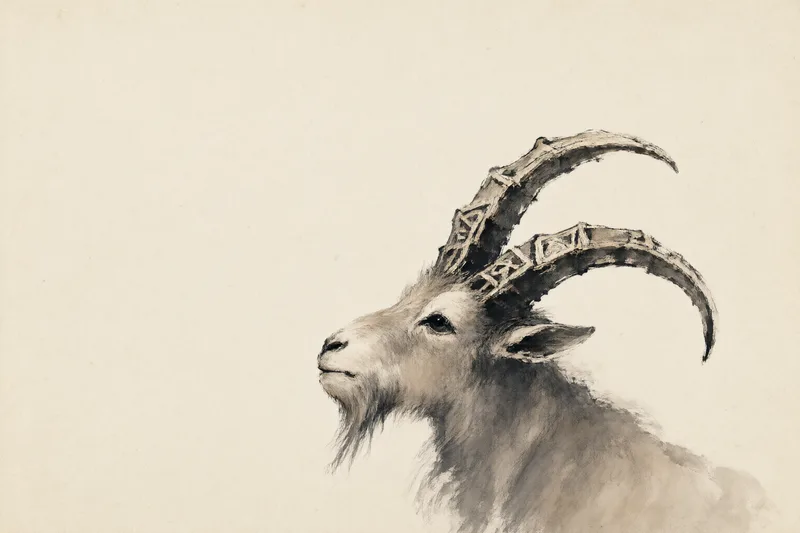
CNN put the question in a headline in 2015: Is it the Year of the Sheep, Goat or Ram? Nobody settled it. The question comes back in January 2027, when the next one arrives.
Search that phrase today and all three answers are still in active use, sometimes on the same page. Reference works file the animal under “Goat (zodiac)” and redirect “Ram (zodiac)” to it. Chinese state media has used all three within a single news cycle.
Nobody is confused about which year it is. Everybody is confused about what to call it.
Any real answer has to start with the Chinese word, not the English ones.
The short answer, and why it does not satisfy anyone
All three translations are defensible. None is wrong. But they are not interchangeable, and the reason they are not interchangeable has nothing to do with Chinese.
The Chinese word is 羊, pronounced yáng. It is a general term. It covers the entire horned, hoofed, wool-or-hair-bearing family that English splits into goat, sheep, and ram. Taxonomically it maps closest to Caprinae, the subfamily that contains both goats and sheep, and it does not stop at the species line.
To get specific, Chinese adds a qualifier:
| Chinese | Pinyin | English |
|---|---|---|
| 山羊 | shān yáng | goat (literally “mountain sheep”) |
| 绵羊 | mián yáng | sheep (literally “cotton sheep”) |
| 公羊 | gōng yáng | ram (literally “male sheep”) |
Bare 羊, with no qualifier, is none of these in particular. It is the category.
English does the same thing in reverse all the time. “Uncle” covers your father’s brother, your mother’s brother, and your aunt’s husband. Chinese needs four different words for those, and a translator working from English into Chinese has to pick one, which means inventing information the original did not contain. That is exactly the situation here, running the other direction.
What the oldest written forms actually show
The character 羊 is one of the oldest in the script. It appears in oracle bone inscriptions from the Shang dynasty, roughly 3,200 years ago, and in bronze vessel inscriptions after that.
It is not a drawing of an animal. It is a drawing of the front of an animal’s head: two horns curving down and out, the line of the face between them, sometimes the ears. The body, legs, and tail are absent. Chinese pictographs often work this way, taking the single most identifiable part and letting it stand for the whole, the same way 牛 (niú, ox) is drawn as a head with two upward horns.
So the character tells you the animal has prominent horns. It does not, by itself, tell you which horned animal.
Scholars have tried to squeeze an answer out of the horn shape anyway. Oracle bone forms of 羊 show both curved horns and straighter ones, and the databases catalog dozens of variants. One argument holds that the older forms lean toward straight or slightly curved horns, which would point to goat, and that goats were domesticated earlier in the Central Plains and appear far more often in excavated Chinese artifacts. Another argument points out that the Shang scribes were not drawing a zoological specimen. They were drawing “the horned animal,” the way an English speaker says “bird” without specifying species.
The debate is unresolved, and the honest summary is that the character was never designed to answer the question we are asking it.
《说文解字》, the Han dynasty dictionary, glosses 羊 as 祥 (xiáng, auspicious) and describes the character as showing “head, horns, feet and tail.” Modern paleographers note that the feet and tail part is not visible in the earliest forms. The definition is a later rationalization, not a record of what the Shang scribes saw.
One more piece of evidence people cite: in classical Chinese, 羊 was used interchangeably with 祥 for “auspicious,” and it forms the semantic root of 美 (beautiful), 善 (good), and 義 (righteousness). Whatever animal it was, the culture attached a favorable reading to it very early.
The three English words carry different baggage
The three English words do not feel the same to an English reader, and that is where the real problem sits.
Goat carries the widest range. A scapegoat takes the blame for others. An old goat is a lecherous man. To get someone’s goat is to irritate them. And since around 2018, GOAT has also meant “greatest of all time,” so the same four letters now carry both the most dismissive and the most flattering sense in the language.
Sheep is consistently unflattering in a specific way: it implies a follower who does not think. Sheeple. Like sheep to the slaughter. Black sheep, which is about family disappointment. The word suggests passivity and herd behavior, and English speakers reach for it when they want to imply someone has no independent judgment.
Ram goes the other direction. It is a male sheep, and the verb “to ram” means to strike with force. It reads as aggressive, physical, masculine. It is also the name of a truck brand, an NFL team, and the Western zodiac sign Aries, which creates a different kind of confusion in a page about Chinese astrology.
Now consider what a Chinese reader brings to 羊年. Gentleness, yes. Also warmth, domesticity, and the auspicious pun on 祥. There is no contempt in it and no particular force. The word sits comfortably, which is why the Chinese discussion about which English noun to use barely exists. The problem is entirely on the English side.
So when a translator picks “Year of the Sheep,” they are not making a neutral choice. They are importing a set of associations about docility that the original does not have. Picking “Ram” imports aggression. “Goat” imports a mixed bag: some insult, some climbing, and now some glory.
China’s neighbors did not agree either
The split is not an English-only phenomenon. Every country that received the zodiac through Chinese cultural transmission made its own call.
Vietnam is the cleanest case. The eighth sign there is the goat, written dê, and Vietnamese sources list it that way without any of the hedging you see in English. Vietnamese also replaced the rabbit with the cat, so this is a zodiac that has already diverged once and did not hesitate to diverge again.
Japan uses the character 羊 and reads it as hitsuji, which unambiguously means sheep. Japanese zodiac goods, decorations, and New Year cards depict a woolly animal.
Korea writes 양 (yang), which is closer to the original ambiguity but is usually rendered into English as sheep or ram depending on who is translating. Mongolia, where sheep and goats are both central to pastoral life, tends to split between ram and sheep.
That map says something useful. If Vietnamese, Japanese, Korean, and English speakers all landed on different animals from the same Chinese character, then the character was never specific enough to force an answer. Each culture resolved the ambiguity using its own local animal.
What the 2015 news cycle revealed
When the last one came around, reporters went looking for an authority. What they found was a roomful of experts who disagreed, politely, in print.
Beatrice Chen of the Museum of Chinese in America told reporters there is no single correct rendering, because it is the same word in Chinese for all three and the choice is simply translation. Isaac Yue, a mythologist at the University of Hong Kong, leaned toward goat. His reason: the written character resembles a horned goat. The folklorist Huang Yang argued the same direction from a different premise. The zodiac is a Han Chinese tradition, he noted, and goats were the more common livestock for Han farmers. Fang Binggui added geography to the mix. The animal gets depicted as a sheep in the north and a goat in the south, following whichever one is common locally.
None of them disagree about a fact. They disagree about which consideration should carry the most weight: the shape of the character, the agricultural history, or the regional custom. That is a translation problem, not a metaphysics problem, and it has no resolution.
Which word to use
For English-language writing about 2027, use Goat. That is the convention this site follows and the one most English reference works have settled on, including Wikipedia’s article, which is filed at “Goat (zodiac).”
Three practical notes for anyone writing or searching.
Search all three terms. Google surfaces good results for “year of the goat 2027,” “year of the sheep 2027,” and “year of the ram 2027.” The results overlap heavily. The shopping results do not. If you are buying a gift or a decoration, try more than one, because sellers tag inconsistently.
Say why, once. If you are writing anything more formal than a social post, add a short parenthetical the first time the animal appears, noting that the Chinese term covers goat, sheep, and ram. It takes eight words and it preempts the comment section.
Do not correct people. There is no error to correct. Someone who writes “Year of the Sheep” has made a different defensible translation choice, not a mistake.
Does the translation change your reading?
No, and the reason is structural rather than diplomatic.
Every calculation in Chinese astrology runs on the Earthly Branch, not on the English noun. The branch here is 未 (wèi), and 未 is a fixed unit with fixed properties. It is Yin Earth. Its hidden stems are 己 (jǐ, Yin Earth) as the primary qi, 丁 (dīng, Yin Fire) as the middle qi, and 乙 (yǐ, Yin Wood) as the residual qi. None of that changes if you call the animal a goat.
2027 is the 丁未 year, the 44th position in the 60-year cycle. 丁 is Yin Fire, so the year stacks Yin Fire over Yin Earth, and fire generates earth in the productive cycle. The previous 丁未 year was 1967, and the one before that was 1907. You can see the full breakdown of what that combination means sign by sign in our 2027 Year of the Goat forecast.
If a practitioner offers you a materially different reading because you said sheep instead of goat, that reading is coming from the practitioner, not from the system. The system never had the information to distinguish them in the first place.
What to call 2027
The Year of the Goat (羊年, yáng nián), also written Year of the Sheep or Year of the Ram, begins on February 6, 2027 and runs to January 25, 2028. Anyone born before that February date is a Horse, not a Goat, which is the single most common zodiac error and worth checking with a birth year calculator before you buy anything with a goat on it.
For the broader picture of how the twelve animals work and where the Goat sits among them, see the complete Chinese zodiac guide. If you want to know how the Goat interacts with your own sign, the compatibility tool runs the six-harmony and clash relationships directly.
Frequently Asked Questions
Is 2027 the Year of the Goat or the Sheep?
Both, and neither is wrong. The Chinese word is 羊 (yáng). It covers goat, sheep, and ram without distinguishing between them. English coverage splits three ways. English has three separate words where Chinese has one. Most English reference works use Goat. Wikipedia's article is filed that way too.
Why do some people call it the Year of the Ram?
Ram is a male sheep, and the zodiac animal has horns, so the word fits visually. Some translators prefer it for a second reason: sheep carries a passive, herd-following connotation in English that ram does not. It is the least common of the three in general use. It does show up regularly in American sports and marketing.
Does it matter which translation I use for my chart?
No. Every calculation in Chinese astrology runs on the Earthly Branch 未 (wèi), not on the English noun. A practitioner who gives you a different reading because you said sheep instead of goat is improvising outside the system.
Which animal is it in Vietnam and Japan?
Vietnam is unambiguous: the eighth sign is the goat (dê), and Vietnamese lists it that way without debate. Japan uses the character 羊 read as hitsuji, which means sheep. Korea and Mongolia lean toward ram or sheep. The disagreement exists across Asia, not just in English.