Chinese New Year Customs, Decoded Through the Five Elements
Red doors, midnight firecrackers, a whole fish and a hidden broom: Chinese New Year customs follow five element logic. Here is the logic, and its limit.
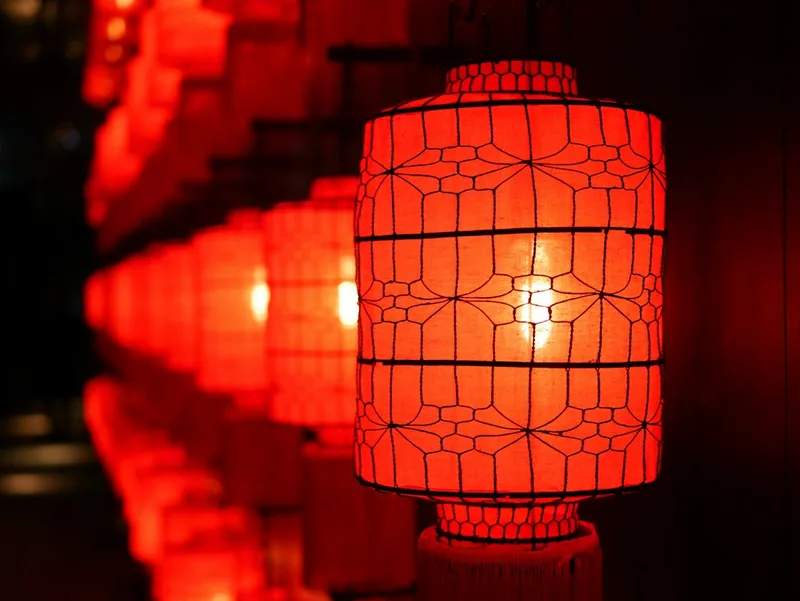
The broom in my aunt’s flat in Taipei spends New Year’s Day behind the refrigerator. She hides it there on the last evening of the old year, after the final pass over the floor, and it comes out again on the second day. Sweep on day one, she says, and you sweep the year’s luck out the door.
I used to treat that as harmless family superstition. Then I started counting the other customs in the same house and noticed they were all pulling in one direction.
Red paper on both sides of the door. Firecrackers at midnight. Every light left burning until morning. A fish served whole, head and tail attached, with a portion deliberately left over. A sticky rice cake whose name means “higher every year.” A thorough cleaning in the week before, then no sweeping for a day after. Children kept awake past their bedtime on purpose, and handed red envelopes for their trouble.
Read as a list, that is folklore. Read as a set of instructions, it is a five element ritual, and a fairly strict one.
The date sits on a seam
Chinese New Year 2027 falls on Saturday, 6 February. The date drifts between 21 January and 20 February depending on the lunar cycle, which means the festival is always near the same solar seam, but never exactly on it.
The solar year turns two days before the holiday. Li Chun arrives at 09:46:18 on 4 February, Beijing time, which is 01:46:18 UTC. In Bazi reckoning the year already changed to 丁未, Fire Goat, before anyone sets out the reunion dinner. The Li Chun guide covers that gap in detail.
For the customs, the calendar detail that matters is smaller and more useful. The first lunar month is the 寅 month, the first month of spring in the solar-term count. In 2027 its pillar is 壬寅, yang water over yang wood.
Water feeds Wood. The month itself is a picture of the season turning, cold water pouring into new growth. The year above it is fire.
That combination is the key to the whole festival. Look at where the holiday sits in the year: the end of winter, the coldest and darkest stretch in the north, the last weeks of the Water phase before Wood takes over. The five elements describe the year as a wheel, and every wheel has a point where one phase is at its weakest. New Year sits on exactly that point. Fire is the element the season is short of.
So the customs add fire, and in the color system the addition is literal. Red is the color assigned to Fire in the classical correspondences. Light and noise belong to the same phase, the one that expands, rises, and makes itself seen. A festival built at the year’s darkest point and stuffed with red, flame, and sound is doing something coherent.
Red, and the door it goes on
The color mapping is old and stable. Wood is green and east. Fire is red and south. Earth is yellow and center. Metal is white and west. Water is black and north. A red door in February is a fire statement placed at the exact coordinates where the year’s qi enters the house.
The door matters as much as the color. In feng shui the entrance is the mouth of the dwelling, the place where outside energy arrives and inside energy leaves. That is why the decoration goes there and not in the living room.
The older form of the decoration was not paper. Door charms were cut from peach wood, a practice recorded in the sixth-century Jingchu Suishiji, a month-by-month account of the year’s customs. The peach wood plaques were called 桃符, peach charms. Paper couplets with paired lines became common much later, usually dated to the Ming.
There is an element chain buried in that history. Peach wood and paper are both Wood. The red is Fire. Wood feeds Fire. The object that guards the door is fuel wrapped in flame, which is a strange thing to hang on a house until you remember what the season is short of.
The couplet form carries a second idea. Two lines, matched in length, tone, and meaning, one answering the other. Yin and yang, written as grammar. A single line would be a wish. A matched pair is a wish with a structure, and the structure is the point.
The door gods belong to a later layer. In most versions they are a pair of Tang generals, Qin Shubao and Yuchi Gong, painted in armor and facing each other. The story says they guarded an emperor’s sleep and then their portraits took over the job. It is a good story, and it is a story rather than a rule.
Noise, and the story attached to it
The old records describe firecrackers before gunpowder existed. Bamboo was thrown into a fire and burst in the heat, which is where the name 爆竹 comes from: exploding bamboo. The Jingchu Suishiji describes the practice at dawn on the first day of the year, in the courtyard, to drive off mountain spirits.
The Nian beast, the horned monster that fears red and loud noise, is a later tale. It is told everywhere, and it is a fine story, but it does not appear in the early texts. What those texts describe is a noise ritual against malicious spirits, not a single beast with a name.
Either way, the element logic holds. Fire is the phase of display. It rises, it shows, it makes sound and light. A dark night in the dead of winter is when that display has the most contrast.
Gunpowder arrived in the Song period and made the noise louder, and the custom scaled up with it. The reasoning did not change. A village lighting firecrackers at midnight is doing what a courtyard did a thousand years ago, with better chemistry.
Clean before the threshold, then stop
The cleaning happens in the week before New Year, and it is not ordinary housework. 扫尘, sweeping the dust, is a pun before it is anything else: 尘 (chén, dust) sounds like 陈 (chén, old, stale). Sweep the dust, sweep the old.
The element reading runs alongside. The old year’s qi has settled into corners. Before a new cycle starts, you empty the container. The Earth phase is doing its job here, the center that holds and stores, cleared out so it can receive.
Then the broom goes into hiding. On the first day, sweeping is avoided in many households, along with throwing water out the door and sometimes taking out the rubbish. The rule is not that dirt is lucky. The rule is that the new year’s arrival is a small, fresh thing, and the first day is when it is most easily lost.
My aunt’s refrigerator is a practical solution to a symbolic problem. The broom still exists. It is just not in service.
What looks like a contradiction is one instruction split in two: clear the house before the door opens, then keep the door’s contents inside. Empty, then contain.
The meal is the center
Not every part of the night is Fire. The reunion dinner, 年夜饭, is Earth: the center, the table, the family held in one place.
In many homes the table is round, and the roundness is the point. Everyone is the same distance from the food and from each other. The seating follows seniority, the dishes are chosen for their names as much as their flavor, and a place is sometimes set for a family member who could not come, or for the ancestors.
That is containment rather than combustion. Fire performs. Earth holds. A festival that only added fire would be a bonfire. The meal is what turns the bonfire into a home.
The dishes are verbs
Most English-language explainers treat the food as a list of lucky items. The dishes are more interesting than that, because each one is doing a job.
| Dish | Name play | Element job |
|---|---|---|
| Whole fish | 鱼 yú, surplus 余 yú | Do not empty the store. Water is the phase of storage, so the fish stays whole, head and tail, with a piece left on the plate |
| Dumplings | 饺子 jiǎozi, said to echo 交子, the crossing at the zi hour | A container of meat and vegetables, made by several hands at one table, boiled and served together |
| Rice cake | 年糕 niángāo, “higher every year” | Sticky and sweet, which is Earth, with a name that points at growth, which is Wood |
| Seven-vegetable soup | Eaten on day seven, 人日, the people’s birthday | Green spring vegetables after a week of rich food. Wood, arriving on schedule |
| Tangerines | 橘 jú, close to 吉 jí, luck | Bought by the box, handed out, peeled constantly |
The fish is the clearest case, and the only one where the pun and the element agree completely. Water governs storage in the five phases, the way winter governs the seed. A whole fish with the head and tail on the plate, and a little left uneaten, is a picture of a store that has not been emptied. 年年有余, every year with surplus, is what the table is saying out loud.
The dumplings are a northern custom, and the link between 饺子 and 交子, the midnight crossing of the old and new years, is popular rather than proven. Treat it as a folk explanation. The shape still reads as an ingot, and the making still needs a table full of hands, which is the part families remember.
Niangao belongs to the south, steamed from glutinous rice, sweet, and often sliced and pan-fried the next morning. Sticky food is Earth in the classical correspondences: sweet taste, digestive work, cohesion. The name lifts it: 年高, year high. Earth holding and Wood rising, in one cold slice.
Then there is the seventh day, 人日, when seven-vegetable soup appears in Cantonese and Hakka households. Seven greens, chopped fine, cooked with dried shrimp or pork. After six days of oil and sugar, a bowl of spring vegetables is the body’s own new year. Green is Wood, and Wood is the phase that has just taken over.
Tangerines are the row in that table where the element column is thin. Nothing in the five element system makes citrus lucky. The pun does the work: 橘 sounds close to 吉. The fruit is a language game with a peel.
Staying awake on purpose
The strangest custom to an outsider is the one with the least decoration. 守岁, guarding the year, means staying up all night. The practice is recorded in the Jin dynasty, in Zhou Chu’s Fengtu Ji: the household stays awake until dawn, and the night is called shou sui.
The lights stay on. Children are allowed, then encouraged, to stay up. Before electric light, a family burning oil through the coldest week of the year was spending real resources on a symbolic act.
In element terms this is the clearest instruction in the whole festival: keep yang awake while yin is at its peak. The year’s darkest hours are also its quietest, and the custom answers with light, voices, and company. Everything else, the red, the firecrackers, the food, is an external version of the same move.
The red envelope fits here too, though its logic is more social than elemental. Red is Fire, and the envelope passes downward, from elders to children, from married to unmarried. The color is the frame. The transfer is the content: a family’s warmth moving around the room instead of sitting still.
The festival has a clock
The fifteen days are not one celebration. They are a sequence with four named stops, and each one changes the rules.
| Day | Name | What changes |
|---|---|---|
| Day 1 | 正月初一, the first day | The new year begins. No sweeping, no breaking things, careful words |
| Day 5 | 破五, breaking the fifth | The taboos lift. Dumplings again in the north, and the broom can come out |
| Day 7 | 人日, people’s birthday | Everyone turns a year older together. Seven-vegetable soup in the south |
| Day 15 | 元宵节, Lantern Festival | Lanterns, sweet rice balls, the end of the holiday |
In 2027 those dates fall on 6 February, 10 February, 12 February, and 20 February. The Lantern Festival is the release valve: the fire of the first night becomes a street of lights, and then the year goes back to work.
A festival with a start, a break, a middle, and an end does something a single party cannot. It gives the year a shape you can feel in your body, which is what the five phases do at a larger scale.
Where the five element reading stops
A lot of writing about Chinese culture goes soft at this point.
Not every custom is element logic. The customs in this festival sit in at least three different layers, and mixing them up is how you end up with a book claiming that the color of a tangerine changes your fortune.
The first layer is structural: season, color, direction, light, threshold. Red on the door in February, lights through the darkest night, a clean house before a new cycle. These map onto the five phases without strain, and they are the ones this article has been reading.
The second layer is calendrical: the sexagenary year, the month pillar, the position of Tai Sui. This is where the technical systems live. In 2027 the year is 丁未, Fire Goat, and Tai Sui sits in the southwest at 未, covering 202.5 to 217.5 degrees. None of that comes from a folk custom. It comes from the calendar, and it can be checked. The 2027 Tai Sui guide and the Fire Goat forecast handle that layer.
The third layer is verbal: homophones, puns, the sound of a word. 鱼 for surplus, 橘 for luck, 糕 for high, 尘 for old. These are real, and they shape real behavior, but they are language, not phase theory. A tangerine is lucky because it sounds lucky. Saying it belongs to Fire because it is orange is the kind of reasoning that makes the whole tradition look silly.
My test is simple. Does the custom point at a season, a direction, a color, a movement of a phase? Then it is element logic. Does it point at a sound? Then it is a pun. Both belong to the festival. They are not the same claim, and a practitioner who blurs them is not doing the tradition any favors.
There is a fourth layer worth naming: local history. Dumplings are northern. Niangao is southern. Seven-vegetable soup is Cantonese and Hakka. What gets called “Chinese New Year” in English is a family of regional festivals sharing a date and a few ideas, not one script performed identically from Harbin to Hainan.
What to do with this in 2027
If you want to use the logic rather than just read about it, the calendar gives you a short list.
Clean in the week before 6 February. The last full day of the old year is 5 February, a Friday, when most of the sweeping gets done anyway.
Put the red up before the door opens on the new year. Couplets, paper cuttings, whatever your household uses. The color is the instruction; the shape is local taste.
Leave a light on. Stay up if you can, at least past midnight, and let the children stay up later than usual. This is the cheapest and most literal version of the custom, and it requires buying nothing.
Serve the fish whole, and do not finish it. The leftover is the point. Put it in the fridge and eat it on the second day, which is what most families actually do.
Skip the sweeping on the first day. Put the broom somewhere inconvenient. Your floor will survive.
Then there is the layer the calendar adds, which the customs do not. In 2027 the first lunar month is 壬寅, water over wood, and the year is 丁未, fire. The old year’s water is still feeding the new year’s growth at the moment the holiday begins. That is a more precise description of early February than any horoscope column will give you.
One more date note. The lunar year that starts on 6 February 2027 contains no Li Chun at all, because Li Chun 2027 falls two days before it starts and Li Chun 2028 falls after it ends. Folk tradition calls that a year without spring and treats it as unlucky for weddings. The Li Chun article explains why the label is a calendar artifact. It has nothing to do with the new year customs, and I mention it only because the question will come up in February.
The broom comes back out
My aunt’s broom reappears on the second day, the floor gets swept, and by the end of the week the flat looks like the holiday never happened.
What stays is the shape of the thing. A cold point in the year. A house cleaned and then closed. Red at the door. Noise at midnight. A fish with its tail on. Everyone awake when they should be asleep.
None of it requires belief in a monster or a lucky fruit. It requires a calendar that knows where it is, and a family willing to spend one night pushing back against the dark. That is what the five elements describe when they work: a schedule, and a set of moves that fit the hour.
The five element guide covers the system itself. If you want to know which phase you carry, the five element quiz takes about four minutes. Neither one will sweep your floor. That part is still yours.
Frequently Asked Questions
Why is red the color of Chinese New Year?
Red is the color assigned to Fire in the classical five element correspondences, and the festival falls at the coldest, darkest point of the year, when Fire is the phase the season lacks. The red door couplets, the red envelopes, and the red clothing all add the same element at the same moment. The older door charms were cut from peach wood, which is Wood, so the object that guards the door combines Wood and Fire.
Why is the house cleaned before New Year but not swept on the first day?
The cleaning happens before the threshold, because the old year's qi has settled and the container should be empty before a new cycle starts. Sweeping on the first day is avoided because the day is when the new year's arrival is freshest and most easily lost. One instruction split in two: clear the house before the door opens, then keep what arrived inside.
What does the whole fish symbolize?
The Mandarin words for fish, 鱼 (yú), and surplus, 余 (yú), are exact homophones, so 年年有余 means a surplus every year. The fish is served whole, with head and tail, and a portion is left on the plate. Water governs storage in the five phases, so a fish that is not finished is a picture of a store that has not been emptied.
Is Chinese New Year a five element holiday?
Part of it is. The color, light, threshold, and storage customs map onto the phases without strain, and the year and month pillars come from the calendar. Other customs, such as the tangerine for luck, are homophone wordplay rather than phase theory. The festival has a structural layer, a calendrical layer, and a verbal layer, and they should not be confused with one another.
When is Chinese New Year 2027?
Saturday, 6 February 2027. Li Chun, the solar start of spring, arrives two days earlier, at 09:46:18 Beijing time on 4 February, which is 01:46:18 UTC. In Bazi reckoning the year pillar has already changed to 丁未, Fire Goat, before the reunion dinner is served. The Lantern Festival closes the holiday on 20 February 2027.