Bazi Health Reading: Element Imbalances and Your Body
Bazi maps the five elements to your body. Learn which organs run hot, which run low, and what your birth chart reveals about your own health and balance.
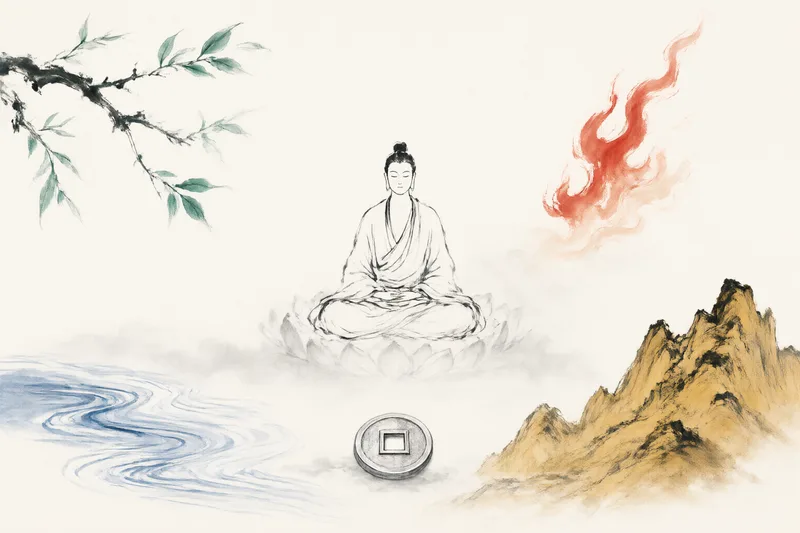
Bazi does not diagnose disease. It maps tendencies, and tendencies have a body attached to them.
A birth chart lays out how the five elements stack up in your life: which ones are plentiful, which are scarce, and how they press against each other. Chinese medicine has read the same five elements as an anatomy for thousands of years. Wood, Fire, Earth, Metal, and Water each govern organs, tissues, and emotions. Put the two systems together and a Bazi chart becomes a map of the body you are likely to live in.
This is not fortune-telling dressed as medicine. It is a way of reading pattern, and the pattern is surprisingly consistent.
The five elements and the body
Every element carries its own territory in the traditional system. Learn this table and most of a health reading is already visible.
| Element | Organs | Opens into | Emotion |
|---|---|---|---|
| Wood (木) | Liver, gallbladder | Eyes, tendons | Anger |
| Fire (火) | Heart, small intestine | Tongue, blood | Joy |
| Earth (土) | Spleen, stomach | Mouth, muscles | Worry |
| Metal (金) | Lungs, large intestine | Nose, skin | Grief |
| Water (水) | Kidneys, bladder | Ears, bones | Fear |
Two cautions before we go further. The “liver” here is not the anatomical organ a surgeon sees. It is a functional system that manages smooth flow, stored blood, and the emotion of anger. And these correspondences are leanings, not certainties. A Wood-heavy chart does not guarantee liver trouble. It describes a system that tends to run that way.
Step 1: Your Day Master is your baseline
Every health reading starts with the same question: how strong is your Day Master?
Your Day Master is the Heavenly Stem of your birth day, and it is your core element. If your Day Master is Wood, your constitution starts from Wood. The organs of Wood, the liver and gallbladder, become your home turf. That is not good or bad. It is simply where your system starts.
You can get your Day Master in seconds with the Bazi Calculator. Enter your birth date and time, and the Day Master appears at the top of the result, along with the full five-element distribution of your chart.
Step 2: Strong or weak changes everything
Here is the core of Bazi health reading. The same element behaves completely differently depending on whether it is strong or weak.
A strong Day Master has plenty of the element it needs. The organs it governs tend to run active, sometimes too active. Excess shows up as heat, tension, overdrive, and the shadow emotion of the element firing on too many cylinders.
A weak Day Master is underfed. The element that should support the core is scarce in the chart, and the corresponding organs tend to run low. Deficiency shows up as fatigue, sluggishness, weakness, and the element’s emotion turning inward.
The four combinations look like this:
| Day Master | What it means | Health tendency |
|---|---|---|
| Strong | Element is abundant | Organs run hot, tend toward excess conditions |
| Weak | Element is scarce | Organs run low, tend toward deficiency conditions |
| Supported | Resource element present | Constitution recovers well, self-healing |
| Clashed | Controlling element attacks | The element’s organs take pressure from outside |
The last two rows matter more than most people expect. A weak Day Master is not doomed, because charts change over time. What matters is whether the element that feeds your Day Master, its Resource, appears anywhere in your chart, and whether some other element is actively attacking it.
What excess looks like, element by element
When an element runs too strong, its organs announce it. The classical descriptions are vivid and easy to recognize.
Too much Wood. The liver runs hot. Headaches behind the eyes, neck and shoulder tension, irritability over small delays, dry eyes after screen time. The Wood emotion, anger, fires fast and cools slow.
Too much Fire. The heart system overworks. Insomnia, a racing mind at night, palpitations, mouth ulcers, a flushed feeling that appears at the wrong moments. The Fire emotion, joy, tips into mania and scattered enthusiasm.
Too much Earth. The stomach and spleen carry a load. Poor digestion, heaviness after meals, a tendency to overthink and chew on the same worry for days. Earth’s emotion is pensiveness, and excess Earth makes a mind that cannot stop reviewing.
Too much Metal. The lungs feel the pressure. Shallow breathing, a tight chest, sensitivity to dry air, skin that flares up. Grief, the Metal emotion, sits close to the surface and takes a long time to pass.
Too much Water. The kidneys run cold. Feeling cold when others are warm, low back ache, water retention, fatigue that sleep does not fix. Fear, the Water emotion, turns into anxiety and a restless need for safety.
What deficiency looks like
A weak element is quieter, because its signs read as ordinary tiredness.
Too little Wood. Low initiative, a body that feels stiff and uncoordinated, vision that tires quickly, and a reluctance to start anything new. The liver’s “smooth flow” has slowed to a trickle.
Too little Fire. A heart that feels underpowered. Cold hands and feet, low energy, a flat mood, circulation that runs slow. Joy is scarce, and enthusiasm needs outside help to arrive.
Too little Earth. A delicate stomach, poor appetite under stress, weak digestion, and a tendency to tire after eating. Worry takes up more room than it should because the Earth system is not strong enough to process it.
Too little Metal. Weak lungs, frequent colds, allergies, sensitive skin. Grief lingers. The Metal function of taking things in and letting them go is underactive, so letting go becomes the hard part.
Too little Water. Kidneys underfed. Low back weakness, dry bones and joints, hair that thins, hearing that dulls. Fear has a larger share of the emotional floor than it should.
The controlling cycle: when elements fight
The five elements do not sit side by side. They control each other, and a health reading is incomplete without the fights.
In the controlling cycle, each element presses on the one after it: Wood controls Earth, Fire controls Metal, Earth controls Water, Metal controls Wood, Water controls Fire. When one element runs strong, it attacks the element it controls. When one element runs weak, the element that controls it pushes it around.
Two examples that show up constantly:
Wood attacks Earth. A Wood-heavy chart feeds the liver and then leans on the Earth system of spleen and stomach. This is the person who is chronically angry and chronically has a delicate stomach. The anger and the indigestion are one pattern, not two.
Water attacks Fire. Too much Water presses on the heart system. This is the classic picture of a cold body and a restless mind, low energy by day and a racing head at night. The tradition calls it heart-kidney imbalance, and the fix is always the same idea: warm the Fire and settle the Water.
A full chart reading looks at every one of these pairings, not just your own element.
Seasons change the balance
Elements are not static. Each has a season when it is naturally strong, and a season when it is weak.
Wood is strong in spring, Fire in summer, Metal in autumn, Water in winter, and Earth in the transition periods between seasons. A chart is read against the season of birth, because a Wood Day Master born in spring is far stronger than the same Wood Day Master born in autumn, when Metal is in charge and cutting it down.
The practical use: your vulnerable element is weakest in its off-season. If your chart shows weak Metal, expect the lungs and skin to need more care in summer and in dry conditions, not only in autumn. The annual cycle gives the reading a schedule, which is something a static personality test never offers.
What to do with this
A Bazi health reading is not a prescription. It is context. Here is how people actually use it.
Understand your baseline. Knowing your Day Master and its strength explains a lot of recurring patterns: why you run hot when others are fine, why your stomach is delicate under stress, why grief hits you harder and stays longer. Naming the pattern is the first half of managing it.
Balance the element that is missing. Every imbalance points to a solution. Excess is balanced by the element that controls it. Deficiency is fed by the element that generates it. A Wood-heavy person adds Metal and Earth to their life, through color, food, activity, and environment. A Water-weak person adds the deep, still practices that build the Water system: rest, sleep, quiet, warmth.
Watch your vulnerable season. Use the element schedule to know when your weaker systems need extra support. Preparation beats reaction, and the calendar tells you when to prepare.
Let it guide, not govern. If your chart says weak Metal and your lungs are fine, the reading is still useful, because it points to a system worth protecting rather than a problem you already have.
Common questions
Can Bazi really tell me about my health? In the traditional framework, Bazi does not diagnose disease. It maps tendencies. Your chart shows which elements are abundant, which are scarce, and how they press on each other, and every element corresponds to an organ system. A Fire-heavy chart points to the heart and circulation, a Metal-weak chart to the lungs and skin. These are leanings you can work with, not verdicts a doctor would sign.
What is the most important piece of a Bazi health reading? The strength of your Day Master. Your Day Master is your core element, your baseline. A strong Day Master means that element has plenty of fuel and its organs tend to run active, sometimes too hot. A weak Day Master means that element is underfed and its organs tend to run low. Everything else in a health reading is detail on top of that single question: is your core element strong or weak?
What does it mean if one element dominates my chart? An overabundant element gives too much energy to the organ system it belongs to, and it also presses on whatever it controls in the five-element cycle. Too much Wood, for example, feeds the liver while also crowding the Earth system of digestion and worry. The dominant element is not bad on its own. It just needs something to balance it, and the missing element is usually the answer.
Is a Bazi health reading a medical diagnosis? No, and it should never replace one. The organ names in Bazi and Chinese medicine are functional systems, not the same as anatomical organs, and the tradition itself is a framework for understanding pattern, not a clinical tool. Use a health reading as context about tendencies and timing. For actual symptoms, see a medical professional. The two views can sit side by side without conflict.
The most useful sentence a Bazi health reading can produce is a simple one: here is your baseline, here is what tends to run hot, here is what tends to run low, and here is when each is most likely to act up. Once you know that, you stop being surprised by your own body, and you can start meeting it where it is.
If you want your own elemental baseline, the free Bazi Calculator gives you your Day Master, your five-element distribution, and your current Luck Pillars in under a minute. For the deeper layer, the AI Bazi Full Report ($19.99) maps your chart against all ten stems, your Day Master strength, your Useful God, and the cycles that change how your system runs over time.
New to Bazi? The Four Pillars Guide explains how a chart is built, and the Day Master Guide covers what each of the ten Day Masters is like.